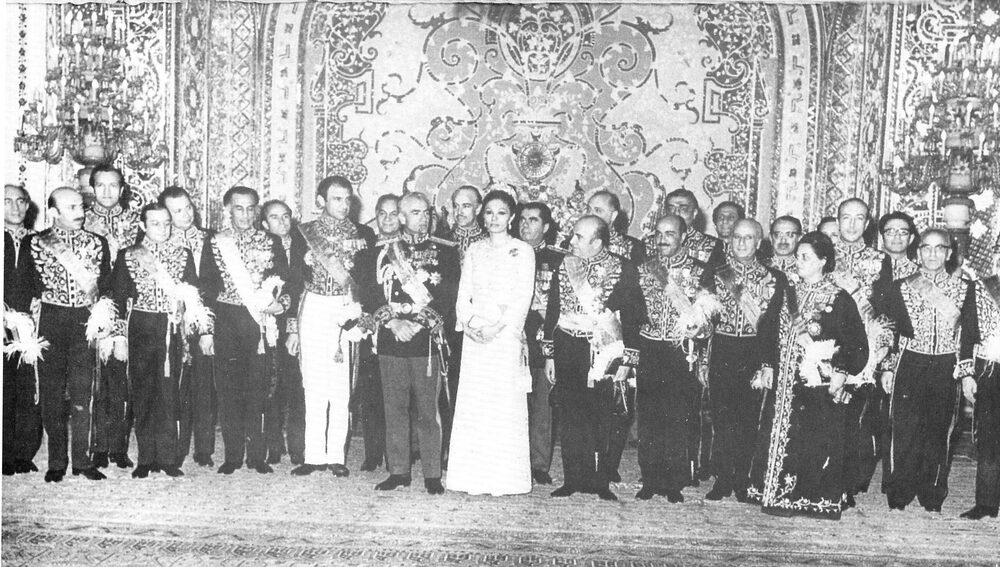
The Class of 1979
In the fall of 1979, the largest group of foreign students at American universities came from a single country. Not China. Not India. Not Japan.
Iran.
Fifty-one thousand three hundred and ten Iranian students were studying in the United States alone — nearly triple the number from Taiwan, the next largest sender.1 Tens of thousands more were scattered across European universities. They were studying engineering, medicine, nuclear physics, computer science. They came from the eighteenth-largest economy in the world, a country that produced twice as many scientific papers as South Korea and was closing the development gap with the West faster than almost any nation on Earth.2
Most of them never went home.
Within two years, their country would undergo a revolution, a hostage crisis, and a war that lasted eight years. The economy they left behind — the one that had sent more students abroad than any other developing nation — would begin a collapse so total that the currency would eventually lose 99.995% of its value.
This is the story of what that collapse looked like, measured in the numbers the Islamic Republic cannot spin.
The Baseline
In 1977, Iran and South Korea occupied very different positions on the global economic map. The distance between them was not close.
| Indicator | Iran (1977) | South Korea (1977) |
|---|---|---|
| Global economic rank | 18th | 28th |
| Scientific papers (1978) | 518 | 260 |
| Students in the US | 51,310 | ~18,000 |
| Currency stability | Rial at 70/$ — stable 15+ years | Won volatile |
| GDP per capita (1976) | $7,422 (constant 2015 USD) | Lower |
| University students | 154,000 (7x from 1960) | Growing |
Iran’s economy had climbed from 29th in 1960 to 18th in 1977 — eleven positions in seventeen years. During the “Golden Decade” of 1963-1972, the economy grew at nearly 10% annually with inflation below 3%. The country had 16,000 university professors, over 14,000 physicians, and a literacy rate that had tripled in two decades. Full employment. Rising wages. An industrial base that was beginning to compete regionally.
South Korea in 1977 was still a developing country under authoritarian rule, ten places behind Iran in economic output and producing half its scientific research.
Today, South Korea’s GDP is 7.2 times Iran’s. Turkey — which ranked 20th in 1977 — now occupies Iran’s old 18th-place spot. Iran has fallen to 27th.
The question this article answers is not whether the reversal happened. It is how much of it was avoidable.
The Honest Ledger
Before diagnosing the collapse, the pre-existing conditions need documenting. Iran’s trajectory in the 1970s was real — but it was also fragile in ways that matter.
The inequality was extreme. Iran’s Gini coefficient in the 1970s ranged from 0.50 to 0.56 — one of the highest in the developing world.3 The “Thousand Families” and the Pahlavi Foundation controlled a disproportionate share of national wealth. Growth was real but skewed heavily toward upper income deciles.
The human development lagged the GDP. Despite oil wealth, Iran’s Human Development Index in 1980 stood at 0.443 — classified Medium-Low. South Korea’s was 0.713 — High. Even Turkey’s was higher at 0.474.4 Iran’s rate of improvement was among the fastest in the world, but it was starting from a deep deficit of illiteracy and poor public health. The convergence was real. It hadn’t finished.
Land reform created losers. The White Revolution’s land redistribution reached 1.8 to 2.5 million families — a genuine transformation. But it excluded the khwushnishins, landless laborers who comprised roughly a third of rural households. Traditional landlord obligations dissolved. These dispossessed families poured into urban slums, becoming the mostazafin — the “disinherited” — who would form the revolution’s street muscle.
Oil became a curse. After the 1973 price shock, when revenues surged from $2.4 billion to nearly $20 billion in four years, the Shah doubled the Fifth Development Plan against the advice of his own economists. Investment increased 56% per year. Ports clogged. Inflation spiraled to 15-20%. Anti-profiteering campaigns alienated the bazaari merchant class — precisely the constituency that would fund the coming revolution.
The revolution had real fuel. The Golden Decade explains how Iran achieved its growth — and how the Shah’s post-1973 decisions destroyed the conditions that made it possible.
The Catastrophe
What followed 1979 was not a correction. It was an economic extinction event.
The Iran-Iraq War (1980-1988) cost an estimated $600 billion in damage.5 Oil production — the economy’s backbone — collapsed from 6 million barrels per day to below 2 million. Capital fled. The government implemented wartime rationing to prevent famine.
The intellectual infrastructure was gutted. University professors were culled from 16,000 to approximately 9,000 by 1982 — a 44% loss in four years. A generation of technocrats who had managed the Golden Decade’s growth was purged, exiled, or killed.
The economy was restructured around state control. Banks, insurance companies, and major industries were nationalized. The constitution enshrined state economic dominance. The bonyads — revolutionary foundations like Setad and Bonyad Mostazafan — replaced the Pahlavi Foundation, eventually controlling up to 80% of the economy with minimal transparency or tax liability. Corruption shifted from court patronage to systemic rent-seeking embedded in multi-tiered exchange rates. Iran’s Corruption Perception Index ranking: 149th out of 180.
By 1988, the numbers were devastating. Real national product equaled that of fifteen years earlier — despite a 60% population increase. Per capita income had fallen to 55% of the 1977/78 level. The country had gone backward by every measure that counted.
Post-war reconstruction under Rafsanjani and Khatami achieved roughly 5% annual growth — respectable but insufficient to recover lost ground. Privatization attempts stalled against bonyad interests. Then came the lost decade: since 2011, Iran has averaged zero growth. The currency has lost over 90% of its remaining value. IMF working papers attribute a 17 percentage point reduction in the middle class directly to post-2011 sanctions — but the domestic mismanagement was chronic long before the sanctions hit hardest.
What They Built
Here is where intellectual honesty requires an uncomfortable acknowledgment: the Islamic Republic built things. Real things that matter.
Rural electrification: In 1972, only 12% of rural households had electricity. By the 2000s, near 100%. The Construction Jihad brought electricity, clean water, and paved roads to villages across the country. Universal access to piped water was achieved. The villager of 2024 has amenities their 1978 counterpart could not imagine.
Steel: Production grew from 1 million tons to 31.1 million tons — a thirty-fold increase that made Iran the world’s tenth-largest steel producer and the second-largest DRI producer globally. This sector is genuinely competitive on world markets.
Petrochemicals: From negligible output to approximately 100 million tons of capacity generating $24 billion in revenue — roughly 30% of non-oil exports. This diversification away from crude oil dependency is a strategic adaptation the Pahlavi economy never developed.
Literacy: From below 50% to 85% adult literacy, 98% for youth. Female university enrollment now exceeds male.
Power generation: From 7,000 MW to over 94,000 MW — a thirteen-fold increase.
Absolute poverty: Largely eradicated compared to the 1970s. The floor was raised.
These are facts, not concessions. A source that pretends the Islamic Republic built nothing forfeits the right to be believed when it documents what was destroyed. The destruction was real. So was the construction.
The Ledger: Construction and Destruction
Islamic Republic achievements vs. losses since 1979
What They Built
What They Lost
The Divergence
In 2018, a group of economists applied the Synthetic Control Method to answer the counterfactual question: what would Iran’s economy look like if 1979 hadn’t happened?6
The method constructs a “Synthetic Iran” — a weighted composite of similar developing nations that did not undergo regime change — and compares its trajectory to Iran’s actual performance.
The findings:
- GDP per capita diverged negatively starting in 1978
- By 1980, real GDP per capita had declined by approximately 20.15% relative to the synthetic counterpart
- Over the first decade (1978-1988), the average Iranian lost an accumulated $34,660 — an average annual per capita income loss of $3,150
- The decline was specifically attributable to regime change, not global trends. “Synthetic Iran” continued upward while real Iran collapsed
But the same analysis revealed something the Shah’s defenders prefer not to mention: the revolution reduced inequality. The Gini coefficient fell from above 0.50 to the 0.35-0.40 range.7 The revolution leveled the playing field — downward. It destroyed upper-class wealth concentration.
The trade: massive aggregate wealth reduction in exchange for structural inequality reduction. Everyone became more equal. Almost everyone became poorer.
The speed differential is the cruelest part. Iran’s rate of improvement in the 1970s was among the fastest in the world. The revolution didn’t just reverse progress — it interrupted the fastest convergence trajectory in the Middle East at precisely the moment the Asian Tigers were accelerating. Counterfactual modeling suggests that had Iran maintained its pre-1979 trajectory, its scientific and industrial output could have rivaled South Korea’s today.
Instead, the two countries crossed paths going in opposite directions. One kept its engineers and built Samsung, Hyundai, and KAIST. The other scattered its engineers across the world — and they built those companies for other countries.
The Divergence: Iran vs South Korea
GDP per capita (current US$), 1960–2024
The Currency Tells the Story
You can debate GDP methodology. You can argue about purchasing power parity and whether Gini coefficients capture real inequality. But you cannot argue with an exchange rate.
| Period | Rials per US Dollar |
|---|---|
| 1960s-1977 | 70-75 (stable peg) |
| Post-revolution | Continuous devaluation through multiple tiers |
| January 2026 | 1,410,000 (free market) |
That is a devaluation of approximately twenty thousand times. The Rial has become, in one researcher’s words, “too small to register on some digital platforms.”
The drivers are structural: sanctions choke the supply of hard currency while the government funds deficits by printing money — monetary base growth vastly outpacing economic output. Inflation averaged 17.2% across the Islamic Republic’s history, reaching 44.6% in 2023 with food prices rising 60-70%.8
What these numbers feel like at the kitchen table is the subject of 112 Years to Buy a Home.
The Autopsy Report
Iran today is a paradox that both sides get wrong.
The supporters point to the infrastructure: the electrification, the steel mills, the literacy rates. They are right that these exist. They are wrong that these constitute prosperity.
The opponents point to the currency collapse, the brain drain, the sanctions-crippled economy. They are right about the devastation. They are wrong to pretend the Pahlavi era had no flaws that fueled the revolution.
The forensic verdict is more precise than either narrative: Iran achieved development without prosperity. It modernized. It industrialized. It educated its population. And it simultaneously impoverished them — building infrastructure while the purchasing power to use it evaporated, educating a generation of engineers while making it impossible for them to stay.
The Pahlavi model was high-growth, high-inequality, globally integrated. The Islamic Republic model is low-growth, lower-inequality, isolationist. Iran traded growth for what the regime calls “resilience” — a Resistance Economy that maintains the state but impoverishes the citizenry through isolation and currency debasement.
The infrastructure is aging. The educated class is fleeing. The dream of homeownership has receded beyond the horizon. And the Paykan — Iran’s national car — tells the whole story in miniature.
The Class of 2026
Return to those 51,310 students.
The ones who stayed in America built companies, taught at universities, practiced medicine. Iranian-born emigrants have tripled since 1979. Iran now ranks first globally in brain drain by some metrics, with an estimated $150 billion per year in lost human capital.9 Between 2020 and 2025, four thousand doctors left Iran annually — along with thousands of engineers.10
South Korea kept its engineers. They built an economy 7.2 times the size of Iran’s.
Iran’s engineers built their careers — somewhere else.
A country that ranked eighteenth in the world now ranks twenty-seventh, with a currency worth one twenty-thousandth of its 1977 value and an economy that has averaged zero growth for over a decade. The country that was ten places behind it has become its economic superior by a factor of seven.
This is not a debate about ideology. It is an autopsy. And the cause of death is written in the ledger.
For the decade that built Iran’s trajectory, see The Golden Decade. For the car that tells the whole economic story in miniature, see The Paykan Index. For what the currency collapse means at the kitchen table, see 112 Years to Buy a Home.
Footnotes
-
Encyclopaedia Iranica, “Education: Education Abroad,” accessed 2026 ↩
-
arXiv, “The 1979 Iranian Revolution and the Lost Decade of Science: A Counterfactual Scientometric Analysis,” 2510.21826v1, 2025 ↩
-
Brookings Institution, “Iran: Poverty and Inequality Since the Revolution,” 2000 ↩
-
UNDP Human Development Report, HDI Trends Table, 2007/2008 edition ↩
-
Jahangir Amuzegar, “Iran’s Post-Revolution Economy,” Wilson Center, 2007 ↩
-
World Scientific, “The Economic Cost of Revolution: The Iranian Case,” S0217590820420072, 2018 ↩
-
Economic Research Forum, “The Impact of Revolution and War on Income Inequality in Iran,” March 2023 ↩
-
Macrotrends, “Iran Inflation Rate: Historical Chart & Data,” CPI data series, accessed 2026 ↩
-
Migration Policy Institute, “Iran Loses Highly Educated and Skilled Citizens during Long-Running Brain Drain,” 2023 ↩
-
Stanford Iranian Studies, “Migration and Brain Drain from Iran,” 2022 ↩