The Morning
On September 8, 1978, Iranians in Tehran woke to martial law.
The announcement had come late the previous night — so late that many never heard it. General Gholam-Ali Oveisi, the military governor of Tehran, had declared a curfew and banned public gatherings. Tanks were positioned at major intersections. Soldiers patrolled the streets.
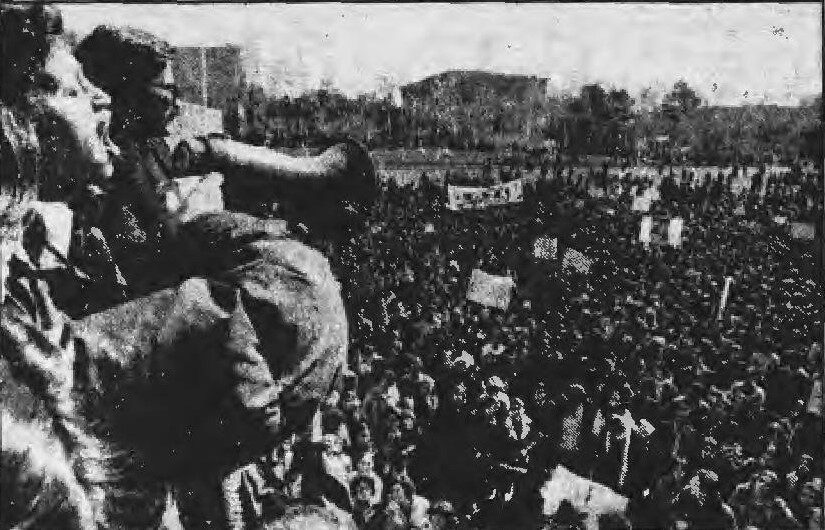
In Jaleh Square, in the southeast of the capital, people gathered anyway.
Some were protesters who had decided to defy the martial law order. Some were residents of the neighborhood who had not heard the announcement. Some were on their way to Friday prayers. The crowd was mixed — men, women, old, young — and it was growing.
What happened next would be amplified, distorted, and weaponized into one of the most consequential inflations in modern political history.
What Happened
Soldiers opened fire on the crowd. The shooting was real. People died in Jaleh Square and in other locations across the capital. This is documented, verified, and indefensible.
The forensic record, assembled from hospital records, morgue registrations, and post-revolution investigations:
88 people were killed. Sixty-four in and around Jaleh Square. Twenty-four in other parts of Tehran.1
The Islamic Republic’s own Bonyad Shahid — the Foundation of Martyrs, which had every financial and political incentive to document the highest possible count — verified this number during its comprehensive audit of revolution-era deaths.
What Was Reported
Within hours, the opposition networks — the mosque loudspeakers, the bazaar rumor channels, the exile telephone trees — reported a very different number.
Four thousand dead.
The claim included vivid details: helicopter gunships strafing the crowd. Tanks rolling over bodies. Israeli soldiers brought in to do the shooting because Iranian conscripts refused to fire on their own people. Piles of corpses carted away under cover of darkness.
None of these details have been verified. The “Israeli soldiers” claim has no evidentiary basis whatsoever. But the details served a purpose that transcended accuracy: they transformed a political crisis into an atrocity, and an atrocity into a point of no return.
How 88 Became 4,000
The inflation didn’t happen in a single moment. It cascaded through a series of amplification stages, each lending credibility to the next.
Stage 1: The mosque network. Within hours of the shooting, Friday prayer leaders across Tehran reported the massacre to their congregations with inflated figures. The mosque system was the opposition’s most effective communication channel — beyond SAVAK’s reach, trusted implicitly by worshippers, and impossible to fact-check in real time. The numbers grew with each retelling.
Stage 2: The exile networks. The Confederation of Iranian Students in the West — an organized diaspora movement that had successfully lobbied European human rights organizations for years — relayed the inflated figures to Western journalists and advocacy groups. These organizations had no independent means of verification. They reported what they were told.
Stage 3: The foreign press. European and American correspondents, operating under martial law conditions that made independent reporting nearly impossible, cited the opposition figures. The numbers entered the Western news cycle not as claims but as reported facts.
Stage 4: The intellectual seal. Michel Foucault, the French philosopher, visited Iran in September 1978 as a special correspondent for the Italian newspaper Corriere della Sera.2 He wrote dispatches from Tehran that uncritically repeated the “4,000 dead on Black Friday” figure. Foucault’s prestige — one of the most influential public intellectuals in the Western world — gave the number a layer of authority that mere journalism could not.
The Amplification Cascade
The mechanism at work is availability cascade — a self-reinforcing process in which a claim gains credibility simply by being repeated. Each repetition makes the claim more “available” in the listener’s mind, and the more available a claim feels, the more true it seems. By the time anyone could have counted the actual dead, the count no longer mattered. The narrative had achieved escape velocity.
The Israeli Soldiers Myth
Among the details that circulated after Black Friday, one deserves particular attention: the claim that Israeli soldiers were deployed to Jaleh Square because Iranian conscripts refused to fire on fellow citizens.
This claim served multiple functions simultaneously. It externalized the violence — making it a foreign atrocity rather than an Iranian one. It connected the Shah to Israel at a moment when anti-Zionist sentiment was a powerful mobilizing force. And it offered an explanation for how soldiers could fire on unarmed civilians — they weren’t really Iranian soldiers.
No evidence has ever substantiated this claim. No Israeli military records, no diplomatic cables, no eyewitness testimony from the soldiers themselves, no forensic evidence of foreign military personnel. The claim was pure narrative construction — designed not to describe reality but to shape the emotional response to it.
The technique is what researchers call source laundering: an unverified claim enters circulation through informal channels, gets repeated by increasingly credible sources, and eventually achieves the status of conventional wisdom. By the time anyone asks “where did this come from?”, the answer is “everyone knows this.”
The Point of No Return
Black Friday’s significance was not the 88 deaths. It was the 4,000.
Before September 8, the political crisis in Iran still contained the possibility of compromise. The Shah had been making concessions — appointing a more liberal prime minister, relaxing press restrictions, signaling willingness to negotiate. Moderate voices on both sides were still trying to find a path between revolution and repression.
After “4,000 dead in Jaleh Square,” compromise became impossible.
If the Shah’s army had killed 4,000 unarmed civilians in a single day — a figure that would place Black Friday among the deadliest single-day massacres in modern history — then no reform, no concession, no promise could redeem the regime. The only moral response to genocide is overthrow. The inflation of 88 to 4,000 didn’t just exaggerate a crime. It eliminated the political space in which anything short of revolution could be considered.
This was not accidental. The opposition leaders who amplified the number understood exactly what they were doing. A massacre of 88 is a crisis. A massacre of 4,000 is an indictment. The difference is the difference between a government that must reform and a government that must fall.
The Inflation Pattern
Black Friday was not an isolated case. It was the most dramatic instance of a pattern that ran through the entire revolution.
The 1963 uprising following Khomeini’s arrest: described as a “massacre of thousands,” verified at fewer than 100 dead. The total revolution-era death toll: claimed at 60,000, verified at 3,164 by the Islamic Republic’s own Martyrs Foundation.3 Cinema Rex in Abadan: blamed on SAVAK, carried out by Islamic extremists.4
The pattern is consistent: real violence, real victims, real crimes — multiplied by factors of ten to fifty, and then hardened into founding mythology that cannot be questioned without being accused of defending the Shah.
The technique exploits a genuine moral intuition: if the Shah’s regime was brutal (it was), then challenging the specific numbers feels like minimizing the brutality. This is the emotional trap that prevents forensic examination of the claims. Anyone who says “88, not 4,000” risks sounding like they’re saying 88 doesn’t matter.
Eighty-eight matters. Every one of those people had a name and a family. The crime was real. What was manufactured was the scale — and the scale was manufactured for a purpose.
What the Inflation Achieved
Imagine your country’s founding narrative included a massacre that turned out to be inflated by 45 times. Not exaggerated by 20 percent or rounded up for emphasis — multiplied by 45. The event happened. People died. But the number that entered history, the number that justified everything that came after, was fabricated in real time by people who understood that a larger number would produce a larger revolution.
Now imagine that the government which used this inflation to justify its seizure of power went on to kill more people in a single summer than the regime it replaced killed in two decades.5 And that it still points to the inflated number as proof that the previous government was worse.
This is Iran’s founding arithmetic. And it is what Emadeddin Baghi’s 3,164 threatens to unravel.
This article is a companion to The Number That Changed Everything. For the full methodology behind the 3,164 figure, see The Baghi Paradox. For the forensic record of SAVAK’s actual methods, see The Apollo.
Footnotes
-
Emadeddin Baghi, Bonyad Shahid forensic audit; corroborated by hospital records and Tehran morgue registrations for September 8, 1978 ↩
-
Michel Foucault, dispatches for Corriere della Sera, September–November 1978; collected in Janet Afary and Kevin Anderson, Foucault and the Iranian Revolution, University of Chicago Press, 2005 ↩
-
Emadeddin Baghi, forensic audit for the Bonyad Shahid; “Casualties of the Iranian Revolution,” academic synthesis ↩
-
Brookings Institution, “The Iranian Revolution: Key Events Timeline”; post-revolutionary prosecution of Cinema Rex perpetrators ↩
-
Amnesty International, “Iran: Blood-Soaked Secrets,” MDE 13/018/1992, documenting 1988 prison massacres ↩