The Researcher
In the early 1990s, a man named Emadeddin Baghi was given what seemed like a straightforward assignment. The Islamic Republic’s Bonyad Shahid — the Foundation of Martyrs and Veterans Affairs — needed someone to conduct a forensic audit. The task: document every person killed by the Shah’s regime and its secret police, SAVAK, between 1963 and 1979.
The purpose was practical, not political. Families of verified martyrs received generous state compensation — pensions, housing, university admissions for their children. The Bonyad needed an accurate census to administer the program. Every incentive pointed in one direction: find as many victims as possible.
Baghi went looking for sixty thousand dead. The Islamic Republic’s constitution enshrined this number in its preamble — the “60,000 martyrs” of the revolution, a figure that Ayatollah Khomeini had repeated until it hardened into scripture.1 It was the founding arithmetic of the state: a number so large it rendered the Shah’s regime irredeemable and the revolution not just justified but inevitable.
Baghi found 3,164.2
Not approximately. Not “around three thousand.” He conducted a forensic audit of every claim, every name, every compensable death across sixteen years. With families financially incentivized to register every last casualty — and with the state itself motivated to validate as many as possible — his data represented a ceiling, not a floor. If anything, he overcounted.
The regime that commissioned his research later imprisoned him for publishing it.
The Founding Myth
The number sixty thousand did not emerge from research. It emerged from a revolution.
During the upheaval of 1978-1979, Khomeini and opposition leaders needed a figure that would place the Shah beyond negotiation — a number so large that any compromise with the monarchy would be morally unthinkable. Sixty thousand served that purpose. It appeared in speeches, in pamphlets, in the sermons that cascaded from every mosque in the country. By the time it was inscribed in the preamble of the new constitution, it had acquired the weight of revealed truth.
Source: Emadeddin Baghi, Bonyad Shahid forensic audit
The mechanism is what scholars call the “Big Lie” technique — a claim so audacious that listeners assume it must have some factual basis, because who would fabricate something so extreme? The number didn’t need to be proven. It only needed to be repeated.
And it was repeated — by European journalists, by exiled opposition groups, by academics who relied on exile testimony rather than forensic evidence, by Michel Foucault, who visited Iran in 1978 and lent Western intellectual prestige to figures he never verified. The Confederation of Iranian Students in the West lobbied human rights organizations with inflated numbers that became canonical facts in the Western imagination.
By the time Baghi sat down with the actual records, the mythology had been circulating for over a decade. His findings didn’t just challenge a number. They threatened the entire architecture of revolutionary legitimacy.
The Forensic Record
Baghi’s audit revealed a story of escalation concentrated almost entirely in the revolution’s final year.
| Period | Verified Deaths | Context |
|---|---|---|
| 1963 Uprising | Fewer than 100 | 32 confirmed in Tehran. Often described as a “massacre of thousands.” |
| Guerrilla War (1971-1977) | 341-368 | Armed fighters: Fedayeen-e Khalq (Marxist guerrillas) and MEK (Islamo-Marxist). Breakdown: 177 killed in gun battles, 91 executed after military tribunals, 42 died under torture, 15 disappeared. |
| The Revolution (1978-1979) | 2,781 | The vast majority of all casualties, concentrated in the final year. |
| Total (1963-1979) | 3,164 |
Multiple independent sources corroborate the order of magnitude. The Tehran Coroner’s Office recorded approximately 895 death certificates during the revolution. Behesht-e Zahra Cemetery logged roughly 768 burials.3 Academic historian Ervand Abrahamian, working independently from SAVAK files and oral histories, arrived at 368 guerrilla deaths for 1971-1977 — within the range of Baghi’s count.4
The inflation factor: 60,000 divided by 3,164 equals 19 times the verified total.
This doesn’t mean 3,164 deaths were acceptable. Every number on that list was a person. But the gap between reality and mythology is not a rounding error. It is a foundational deception — the difference between a repressive authoritarian state (which the Shah’s Iran was) and the genocidal monster that the revolution required him to be.
The Day They Multiplied by Forty-Five
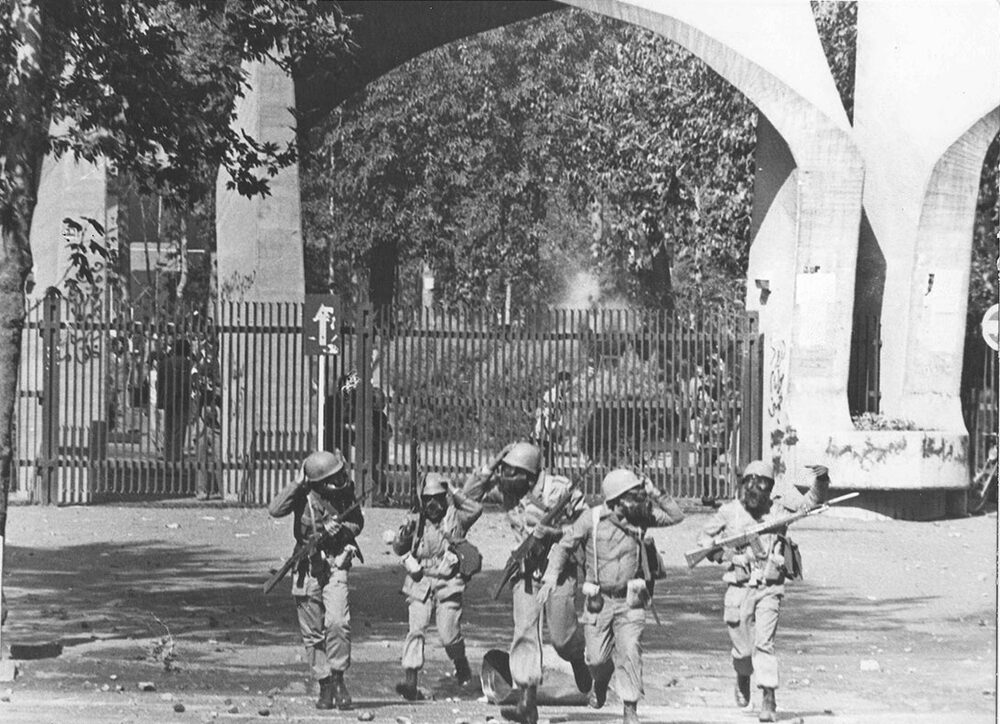
On September 8, 1978 — a date Iranians call Black Friday — soldiers opened fire on protesters in Jaleh Square, Tehran. Martial law had been declared that morning. Demonstrators gathered anyway.
The verified death toll: 88 people. Sixty-four in Jaleh Square. Twenty-four elsewhere in the capital.5
The number reported by the opposition, by European correspondents, and by Foucault in his dispatches: 4,000.6
An inflation factor of 45.
The mythologized 4,000 included claims that Israeli soldiers had been brought in to do the shooting because Iranian conscripts refused to fire on their own people. No evidence supports this. But the claim served the same purpose as the 60,000 — it made the Shah’s regime into something inhuman, something with which no negotiation was possible.
After “4,000 dead in Jaleh Square,” compromise with the monarchy was finished. The revolution’s trajectory was locked.
Eighty-eight people were killed by their own government that day. That was real, and it was a crime. But the distance between 88 and 4,000 is the distance between a political crisis and a point of no return — and the revolution’s architects understood exactly what that distance could achieve.
For an hour-by-hour reconstruction of September 8, 1978 — how 88 became 4,000 in real time, and how a single day’s inflation sealed the revolution’s path — see Black Friday: 88.
The Cinema That Burned
In August 1978, the Cinema Rex theater in Abadan was set on fire. Between 377 and 470 people died — locked inside a burning building.
The revolutionaries blamed SAVAK immediately. The accusation spread through the mosque networks and the bazaar within hours. It became one of the pivotal radicalizing events of the revolution: proof that the Shah’s regime would burn its own citizens alive.
After the revolution, the truth emerged. The fire was set by Islamic extremists who viewed the cinema as showing un-Islamic films. The perpetrators were prosecuted by the new government.7
The narrative of SAVAK guilt persisted for years anyway. By the time the correction reached the public, it no longer mattered. The emotional architecture of the revolution had already been built on the lie.
The Comparison No One Makes
Here is the context that the founding myth was designed to obscure.
| Regime | Deaths | Period |
|---|---|---|
| SAVAK (Shah’s secret police) | 3,164 | 16 years (1963-1979) |
| Islamic Republic (1981-1985 alone) | 8,000-9,500 executed | 4 years |
| Islamic Republic (1988 prison massacres) | 3,800-5,000+ in one summer | Weeks |
| Islamic Republic (January 2026) | 3,117 (regime’s own admission) to 36,500 (leaked IRGC documents) | 48 hours |
The Islamic Republic executed more political prisoners in a single summer — the 1988 massacres, when “Death Commissions” hanged prisoners in groups of six at half-hour intervals — than SAVAK killed in its entire existence.8
In January 2026, the regime’s own admission of 3,117 dead in two days nearly matched SAVAK’s entire sixteen-year toll. Independent estimates from medical professionals and leaked government documents place the number between 6,000 and 36,500. The regime killed more people in a weekend than the mythology claims SAVAK killed in a generation.
The Comparison No One Makes
Political killings: SAVAK's 22-year total vs. Islamic Republic events
The regime that commissioned Baghi’s audit understood the danger of this comparison. A system that justifies its existence by claiming the previous regime killed 60,000 people cannot afford to have that number forensically reduced to 3,164 — because then the question becomes: who has killed more?
The answer is not ambiguous. It is arithmetic.
What SAVAK Won — And What It Cost
By 1977, SAVAK had won its war.
The Fedayeen-e Khalq, the Marxist guerrillas who had launched their armed campaign with the Siahkal attack in 1971, were destroyed. Their leader, Hamid Ashraf, was killed in SAVAK raids. The MEK, the Islamo-Marxist organization that had assassinated three American military officers — Lt. Col. Lewis Hawkins, Col. Paul Shaffer, and Lt. Col. Jack Turner — was “fractured and infiltrated.” The Tudeh Party, the traditional communist movement, was “thoroughly infiltrated” and largely neutralized, with many members forced into public recantations.
SAVAK crushed the armed left.9 And in doing so, it made the revolution possible.
By eliminating every organized secular opposition movement, SAVAK inadvertently cleared the field for the one force it couldn’t fully close down: the clerical network. Mosques had a form of sanctuary status. The Friday prayer structure provided a ready-made organizing system that no security service could dismantle without provoking a religious backlash the Shah was unwilling to trigger.
SAVAK won the battle against the guerrillas and lost the war for the soul of the nation. It created a monster in the public imagination that eventually devoured the throne it was built to protect.
What This Article Is Not
This is not a defense of SAVAK.
SAVAK used systematic torture. This is documented by the International Committee of the Red Cross, which gained access to Iranian prisons in 1977 and found “evidence of physical mistreatment.” The methods included the bastinado — whipping the soles of the feet — the “Apollo,” a helmet that amplified screams while electric shocks were administered, and the “Hot Grill,” an electrically heated metal bed. After 1971, interrogators were sent abroad for what SAVAK euphemistically called “scientific training” — a shift from crude beatings to calculated psychological and physical torture.
These methods are indefensible. They matter. They should be documented with the same forensic rigor applied to every other claim in this article.
For the full forensic record of SAVAK’s torture methods — verified by ICRC inspection, academic research, and survivor testimony — see The Apollo. Documenting real abuses honestly is what makes the statistical argument credible, not less.
The point is not that the Shah was good. The point is that the founding arithmetic of the Islamic Republic is a fabrication — and that the regime which inflated SAVAK’s toll by 19 times has itself killed more people than the mythology it manufactured.
The Shah’s Iran was an authoritarian modernizing state with genuine crimes. The Islamic Republic is a system that executed more prisoners in a single summer than SAVAK killed in two decades, then built its entire legitimacy on the claim that the previous regime was worse.
The Monster in the Archive
Emadeddin Baghi found 3,164 names in the Martyrs Foundation records. For his trouble, the regime that paid him to count the dead punished him for telling the truth about what he found.
His data sits in an archive, verified by the very institution that had every reason to inflate it. The financial incentive pointed toward overcounting. The political incentive pointed toward inflation. And yet the number refused to grow beyond 3,164 — because the dead are finite, even when the mythology is not.
The Islamic Republic’s constitution still carries the number 60,000 in its preamble. It remains the founding equation of the state: the arithmetic that makes the revolution righteous and the monarchy irredeemable.
But arithmetic has a way of catching up. When the regime’s own researcher proved that the founding number was inflated by nineteen times — and when the regime’s own violence has since eclipsed everything it accused the Shah of — the question stops being about history.
It becomes about the present: what else has been multiplied by nineteen?
For the full methodology behind Baghi’s audit — why the Martyrs Foundation census is the most reliable data we have, and why 60,000 is statistically impossible — see The Baghi Paradox.
For an hour-by-hour reconstruction of Black Friday — how 88 became 4,000 and sealed the revolution’s path — see Black Friday: 88.
For the forensic record of SAVAK’s torture methods — the real abuses that make the statistical argument credible — see The Apollo.
Footnotes
-
Preamble, Constitution of the Islamic Republic of Iran, 1979; Casualties of the Iranian Revolution, Wikipedia, citing Khomeini’s repeated public statements ↩
-
Emadeddin Baghi, forensic audit for the Bonyad Shahid (Foundation of Martyrs and Veterans Affairs), published 1990s ↩
-
Tehran Coroner’s Office death certificates and Behesht-e Zahra Cemetery burial records, as compiled in “Casualties of the Iranian Revolution” analyses ↩
-
Ervand Abrahamian, Tortured Confessions: Prisons and Public Recantations in Modern Iran, University of California Press, 1999 ↩
-
Baghi / Bonyad Shahid forensic verification of Black Friday casualties, corroborated by hospital and morgue records ↩
-
Michel Foucault, dispatches for Corriere della Sera, September 1978; Confederation of Iranian Students reports to Western media ↩
-
Brookings Institution, “The Iranian Revolution: Key Events Timeline”; post-revolutionary prosecution records of Cinema Rex arsonists ↩
-
Amnesty International, “Iran: Blood-Soaked Secrets,” MDE 13/018/1992, December 1992 ↩
-
MERIP, “The Guerrilla Movement in Iran, 1963–1977,” March 1980; SAVAK operational files cited in Abrahamian, Tortured Confessions ↩