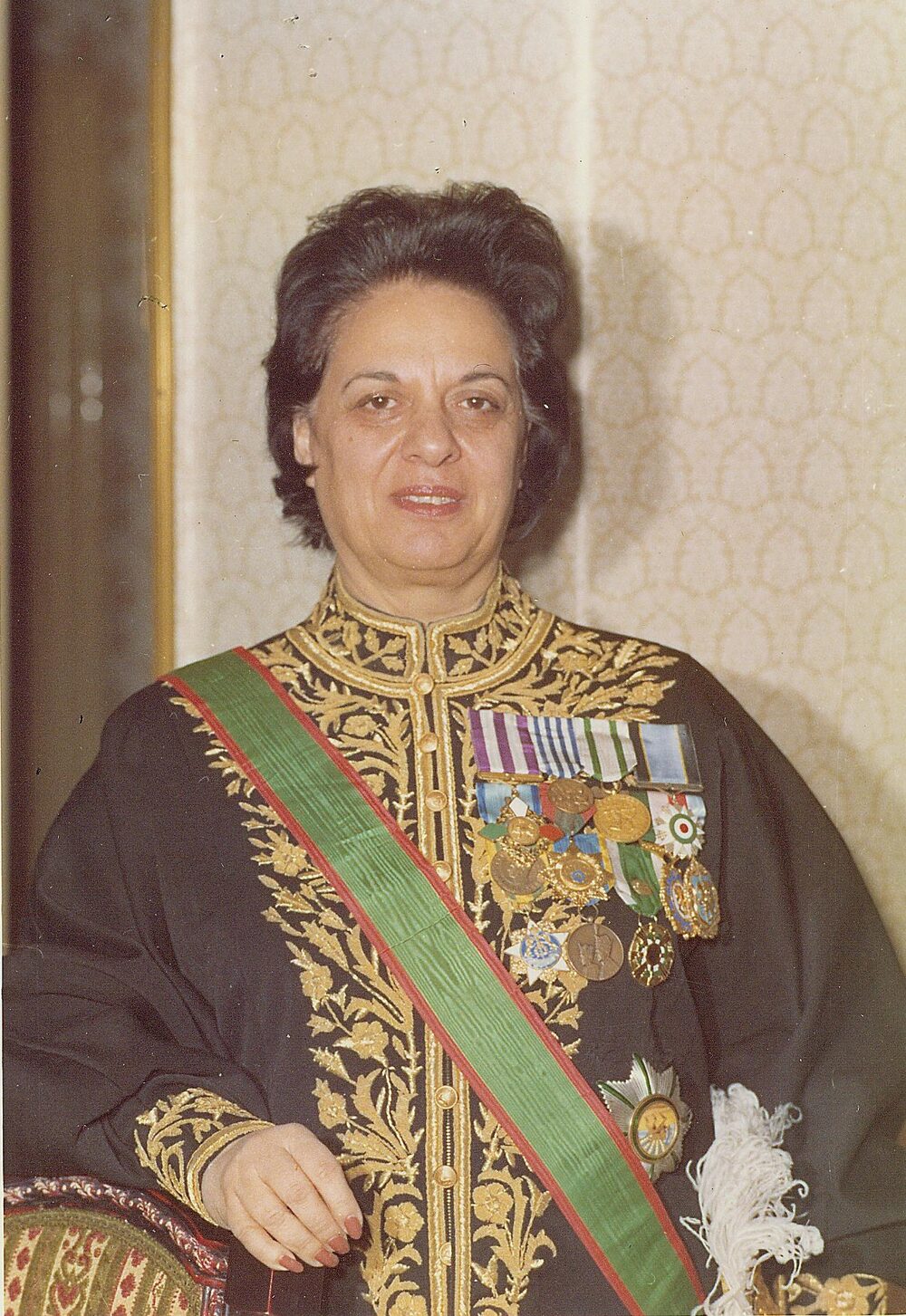
The Letter
On May 8, 1980, Farrokhroo Parsa wrote her last words.1
She was fifty-eight years old. She held a medical doctorate. She had served as Iran’s first female cabinet minister — Minister of Education under Shah Mohammad Reza Pahlavi. She had spent two decades fighting to put books in the hands of girls who had never been allowed to hold them.
Now she was in Evin Prison, sentenced to death.
“I am a doctor, so I have no fear of death. Death is only a moment and no more. I am prepared to receive death with open arms rather than live in shame by being forced to be veiled. I am not going to bow to those who expect me to express regret for fifty years of my efforts for equality between men and women. I am not prepared to wear the chador and step back in history.”
They put her in a sack before they shot her — to prevent male executioners from seeing a female body. The ropes holding the sack broke. They bound her with wire. She was shot three times.
I am not prepared to wear the chador and step back in history. I believe in what I have fought for. If it is God's will that a woman should be covered, He would have created her so.
Farrokhroo Parsa’s name has been missing from every Western story about Iran for forty-five years. There’s a reason for that. Western coverage of Iran runs on a crisis loop — hostage crisis, nuclear standoff, “axis of evil,” repeat. Each crisis overwrites the last, and nothing that doesn’t fit the loop survives. A century of Iranian women fighting for their own freedom has been edited out of the frame entirely.
But her story is the story of Iran. And understanding it changes everything about how you see what’s happening there right now.
Born in Exile
The thread begins before Farrokhroo.
In the early 1920s, her mother Fakhr-e Afagh Parsa was running a magazine called Jahan-e Zanan — Women’s World — in the holy city of Mashhad. It was exactly as radical as it sounds. In the fourth issue, she published editorials on “The Necessity of Girls’ Education” and the need for reform of the marriage law.2 She argued that women’s suffering wasn’t divine fate but enforced ignorance, and linked the absence of education to domestic violence: women must “inform themselves” to avoid “suffering or dying from beatings.”
The clerical reaction was immediate. Mullahs incited mobs who attacked the magazine’s offices and looted the Parsa family home. The government — rather than protecting the journalist — capitulated to religious pressure and banished Fakhr-e Afagh into internal exile.
The destination: Qom — the theological heartbeat of Shia Islam.
And here is the first of many ironies in this story: Farrokhroo Parsa was born on March 24, 1922 — Nowruz, the Persian New Year — in Qom, under her mother’s exile.3 The woman who would become the symbol of secular female empowerment in Iran entered the world in the city that would later become the ideological command center of the revolution that killed her.
But Fakhr-e Afagh wasn’t the beginning either. The thread reaches further back.
During the Constitutional Revolution of 1906–1911 — Iran’s first experiment with democracy, built by Iranians for Iran, decades before most Westerners think the country had any democratic tradition at all — women were not observers. In Tabriz, the Anjoman-e Zanān (Women’s Association) smuggled food and medicine through royalist siege lines. Some disguised themselves as men to fight in the trenches. When the bodies of the fallen were recovered, comrades were shocked to find female fighters among the dead. The Tabriz women’s committee used newly installed telegraph lines to draft appeals to the Queen of Italy and the British Foreign Office — one of the earliest instances of Iranian women attempting to shape international opinion.
And a decade before that, in 1895, Bibi Khanoom Astarabadi wrote Ma’ayeb al-Rejal — “Failings of Men” — a blistering satirical response to a popular misogynistic pamphlet that demanded “absolute obedience” and “silence during meals” from women. Bibi Khanoom’s retort attacked men who “waste family wealth on gambling and alcohol.” It is widely considered the first declaration of women’s rights in modern Iranian history.
The women Iran “forgot” were never gone. They were silenced, exiled, imprisoned, and killed. But the thread never broke.
The Thread
The Minister
Farrokhroo grew up in a household where women’s rights wasn’t an abstraction. It was a dangerous lived reality that had cost her family their home and freedom.
She earned a medical doctorate from the University of Tehran in 1950, specializing in pediatrics. Then she made a pivotal choice: rather than private practice, she stayed in public education. As she later explained — one treated the body, the other the mind.
She took a position teaching biology at the Jeanne d’Arc School, a prestigious French-language institution in Tehran. Among her students: Farah Diba, who would later marry Mohammad Reza Shah — a student-teacher relationship that gave Parsa a powerful ally within the royal court.
In 1963, during the White Revolution — a sweeping modernization program — Iranian women won the right to vote.4 Ayatollah Khomeini, then a mid-ranking cleric in Qom, denounced it as tantamount to “prostitution.” The referendum passed anyway. In September 1963, six women were elected to Iran’s parliament — the first in the country’s history. Farrokhroo Parsa was one of them.
Five years later, she became Minister of Education — the first woman to hold a cabinet position in Iranian history.
What she did with that position is the part that deserves to be remembered.
She launched a comprehensive review of school textbooks to purge sexist imagery — replacing depictions of women as only wives and mothers with women as professionals and scientists. She expanded the Literacy Corps (Sepah-e Danesh), sending young conscripts into remote villages to teach girls who had no schools. She fought to remove the chador from classrooms as an impediment to physical education and mobility.
For this, mullahs spread rumors that she was “encouraging debauchery” and “turning schools into centers of vice.” They accused her of being Baha’i — a persecuted religious minority — to delegitimize her. She denied it consistently. At her trial years later, the fabrication became “evidence” of treason.
The broader legal revolution was equally transformative. The Family Protection Law of 1967 — strengthened in 1975 — reshaped the material conditions of millions of women’s lives:5
| Before 1967 | After the Family Protection Law |
|---|---|
| Divorce was the husband’s unilateral right | Courts adjudicate; wives can initiate on equal grounds |
| Polygamy: up to 4 wives, unlimited temporary marriages | Required court permission AND first wife’s consent |
| Custody: automatically to the father | Determined by court — “best interest of the child” |
| Marriage age: 13 for girls (often younger in practice) | Raised to 18 for girls |
By 1969, five female judges had been appointed — among them a young lawyer named Shirin Ebadi. By 1978, there were 22 women in parliament, 333 on local councils, and women made up one-third of university students.
The literacy revolution: Female adult literacy in Iran — 8% (1956) → 17.4% (1966) → 35.5% (1976). The rate doubled in a single decade.
A woman born in exile in the holiest city of Shia Islam had done more to advance women’s legal standing in the Middle East than perhaps anyone of her generation.
The Literacy Revolution
Female adult literacy in Iran under Parsa's influence
The Promise
From his exile in Neauphle-le-Château, outside Paris, Ayatollah Khomeini said the things that needed to be said.
“Women are free in the Islamic Republic in the selection of their activities and their future and their clothing.”
He dismissed fears of theocracy: “Islam has never been against their freedom.”
Western journalists reported these assurances at face value. Secular revolutionaries took them on faith. Women who had marched against the Shah joined the revolution, trusting that their gains — won over decades, codified in law — were safe.
Imagine that. Imagine spending your adult life building something — legal rights, educational infrastructure, a generation of literate girls — and being told by the incoming government that it would all be preserved.
Then Khomeini returned to Tehran. The reversal was immediate.
February 1979 — two weeks after the revolution: the Family Protection Law was suspended. Unilateral male divorce was restored. The marriage age for girls was lowered from eighteen to nine.6
March 7, 1979: Khomeini decreed hijab mandatory in government ministries.
March 8, 1979 — International Women’s Day: Tens of thousands of women took to the streets. American feminist Kate Millett marched alongside them, recording what she called her “Whisper Tapes.” The women chanted: “We did not make a revolution to go backwards.” Pro-regime thugs attacked them with knives, stones, and acid.
The judiciary was purged. Women were banned from serving as judges. Shirin Ebadi and her colleagues were stripped of their titles and demoted to administrative clerks — in the very courts they had once presided over. The regime declared women “too emotional” to render judgment.
Everything Farrokhroo Parsa had built was dismantled in weeks.
The Reversal
1978
- 22 women in parliament
- 5 female judges
- Minimum marriage age: 18
- Women = 1/3 of university students
- Family Protection Law in effect
1979
- 0 women in parliament
- 0 female judges
- Minimum marriage age: 9
- Women barred from 97 university subjects
- Family Protection Law repealed
The Sack and the Wire
She was arrested on February 16, 1980, at the home of her son.
The trial was conducted by the Islamic Revolutionary Court — no defense attorneys, no right to appeal. The presiding judge: Sadegh Khalkhali, known as the “Hanging Judge,” a man who would later boast about the number of people he had sentenced to death.7
The charges were a mosaic of the moral and the political: “corruption on earth,” “warring with God,” “spreading prostitution” — this last charge directly linked to allowing schoolgirls to wear uniforms that exposed their legs during sports. Her Ministry of Education was described as a “brothel.” She was accused of “plundering the national treasury” — she pointed to her modest lifestyle as refutation.
Unlike male ministers who wept and begged for their lives, Parsa stood firm. She refused to wear the chador in court, appearing in a headscarf and trench coat.
“I want to put the task of educating the country’s children in a mother’s hand,” she told the court. “I want our minister of education to consider other people’s children as her own.”
When accused of turning girls into prostitutes by removing the veil from schools, she replied: true morality comes from the mind, not from cloth.
She was executed on May 8, 1980. Put into a sack. The ropes broke. Bound with wire. Shot three times.
Her final letter — now a sacred text of the Iranian women’s movement — has survived every attempt to erase it.
The Thread Continues
Forty-two years later. September 13, 2022.
Jina Amini — twenty-two years old, visiting Tehran from Saqqez in Kurdistan Province — was stopped near the Haqqani Metro Station by Iran’s morality police for “improper hijab.” Her brother Kiarash was beaten when he tried to intervene. She was shoved into a police van.
She collapsed into a coma at the detention center. The regime claimed “sudden heart attack.” Leaked CT scans from Kasra Hospital revealed the truth: skull fracture, hemorrhage, and cerebral edema consistent with severe blunt force trauma.8
She died on September 16. Her real name — Jina, meaning “life” in Kurdish — had been banned by the civil registry. The state that killed her had never even allowed her name.
At her funeral in Saqqez, thousands gathered despite security warnings. Women removed their headscarves and waved them overhead. And then a chant arose — first in Kurdish, then translated into Persian, then echoing across 134 cities and 132 universities:
“Jin, Jiyan, Azadî.”
Woman. Life. Freedom.
What followed was the largest uprising in the Islamic Republic’s history. And the regime’s response revealed the thing it has always been.
Nika Shakarami, sixteen, burned her hijab on a dumpster. She was detained by an undercover IRGC unit designated Team 12. A leaked internal report — later verified by BBC Eye — documented what happened:9 she was sexually assaulted by three men in a van, bludgeoned to death, her body dumped on a highway. The regime told her family she “fell from a building.”
Sarina Esmailzadeh, sixteen, a YouTube vlogger who made videos about freedom and women’s rights. Beaten to death with batons in Karaj. The regime said she “jumped from a roof.”
Kian Pirfalak, nine years old. Shot dead by security forces while sitting in his parents’ car. He was known for a home video testing a toy boat in which he said: “In the name of the God of the Rainbow.” The regime blamed “terrorists.”
Security forces fired birdshot at protesters’ faces at close range — a deliberate campaign of maiming. Over 140 Iranian ophthalmologists signed a letter warning of an “epidemic of eye injuries.” More than 580 people lost their sight. Ghazal Ranjkesh posted a photograph of her empty eye socket with the caption: “The last image my eye saw was the smile of the person shooting me.”
The scale of 2022: 551+ protesters killed (68 children, 49 women) · 22,000+ arrested · 7 executed · 580+ deliberately blinded · 134 cities · 132 universities
The charge used against Farrokhroo Parsa in 1980 — “corruption on earth” — was the same charge applied to rapper Toomaj Salehi in 2022 for the crime of making music about freedom.
The playbook hadn’t changed in forty-two years. Neither had the courage.
Woman, Life, Freedom — By the Numbers
Sources: Iran Human Rights, HRANA, Amnesty International
What They Could Not Kill
Here is the paradox the regime cannot escape.
After 1979, the Islamic Republic invested heavily in rural education — for its own ideological purposes, to spread its version of Islam to every village. The literacy infrastructure that Parsa helped build was expanded, not dismantled. In doing so, the regime produced its own undoing.
Female literacy in Iran: 8% (1956, before Parsa) → 35.5% (1976, Parsa era) → 85%+ (2021)
Women now outnumber men in university entrance exams. Female enrollment exceeds 60%. The girls Farrokhroo Parsa fought to educate became the grandmothers of girls who won’t stop reading.
And the regime’s own polling data shows what educated populations do. According to GAMAAN surveys (2024–2025): 73% of Iranians support the separation of religion and state. 68% explicitly oppose the Islamic Republic. Only 19.5% support the current system. By 2025, the regime itself acknowledged that strict enforcement of its hijab laws “could trigger a regime-ending explosion” — and suspended enforcement.
Walking unveiled in Tehran, Shiraz, and Rasht has become normalized civil disobedience. The generation that grew up after 2022 — the “Mahsa Generation” — hasn’t just rejected the hijab. They’ve rejected the entire premise of political Islam.
Three generations. One thread.
Fakhr-e Afagh Parsa demanded women be educated. The Voice. (1920s)
Farrokhroo Parsa demanded women govern. The Agency. (1960s)
Jina Mahsa Amini demanded women live. The Autonomy. (2020s)
The execution of Farrokhroo Parsa was an attempt to kill the future. The “imperialist culture” she was accused of importing has become the indigenous culture of Iranian youth. The women fighting today are the spiritual granddaughters of a pediatrician from Qom who believed that if you teach girls to read, everything else follows.
She was right.
The Thread Complete — Three Generations
"Educate us"
"Let us govern"
"Let us live"
The Paradox: Seeds Planted, Revolution Grown
Female adult literacy in Iran, 1956–2021
The Honest Part
A note on what this article doesn’t pretend.
Reza Shah’s forced unveiling in 1936 — often cited as a precursor to Parsa’s reforms — was implemented with police violence that traumatized traditional women and created a lasting cultural schism. The history of secularization in Iran is not a clean liberator-versus-oppressor narrative.
The Family Protection Law disproportionately benefited urban, middle-class women. Rural women’s lives changed more slowly.
Parsa’s vocational training targets were never met — she aimed for 40% of students in vocational programs; the figure peaked at 7.4%.
The post-1979 literacy gains are real. The Islamic Republic did expand rural education, even if for ideological purposes. Dismissing those gains would be dishonest.
The opposition’s path to unity has been painful. The Georgetown Coalition of 2023 — which brought together figures as diverse as Reza Pahlavi, Shirin Ebadi, and Masih Alinejad — collapsed within months over ideological infighting, regime sabotage, and the unresolved question of whether a post-regime Iran should be a unitary state or a federation. But what conference rooms couldn’t achieve, the streets did. The uprising of 2025–2026 united merchant and worker, monarchist and secularist, Kurd and Persian — not through a negotiated charter, but through a shared reckoning with a theocracy that had nothing left to offer but bullets. The old debates haven’t vanished — Pahlavi’s support still drops below 20% in Kurdistan, and the federalism question remains structurally unresolved. But the movement has a coherence now that it lacked in 2023.
None of this weakens the story. It makes it real. History isn’t useful when it’s simple. It’s useful when it’s honest.
Farrokhroo Parsa’s grave has been deliberately left unmarked by the Islamic Republic. Her final letter survives anyway.
The women she taught to read have not forgotten her.
→ How much do you actually know about Iran? Take the quiz.
Footnotes
-
IranWire, “Iranian Influential Women: Farrokhru Parsa (1922-1980),” biographical profile and execution details ↩
-
FakhrAfagh Parsa, Jahan-e Zanan (Women’s World) magazine, fourth issue, Mashhad, early 1920s; documented in Wikipedia, “FakhrAfagh Parsa” ↩
-
Abdorrahman Boroumand Center, “Farrokhru Parsa: One Person’s Story,” biographical record confirming birth date and location ↩
-
Foundation for Iranian Studies, “Women’s Milestones: Pre-Revolution,” documenting the 1963 White Revolution suffrage referendum ↩
-
Women’s Learning Partnership, “Family Protection Act of Iran,” translated text and legal analysis of the 1967 and 1975 versions ↩
-
Atlantic Council, “Iran and the Women’s Question,” IranSource, documenting the post-revolution rollback of the marriage age and family law ↩
-
Abdorrahman Boroumand Center, trial record of Farrokhroo Parsa before the Islamic Revolutionary Court, presided over by Sadegh Khalkhali, 1980 ↩
-
OHCHR (UN Office of the High Commissioner for Human Rights), “Justice and Accountability: Woman, Life, Freedom Protests,” documenting the death of Jina Mahsa Amini, April 2025 ↩
-
BBC Eye Investigations, report on Nika Shakarami’s detention and death by IRGC Unit “Team 12,” verified from leaked internal documents, 2022 ↩