The Man on the Scaffold
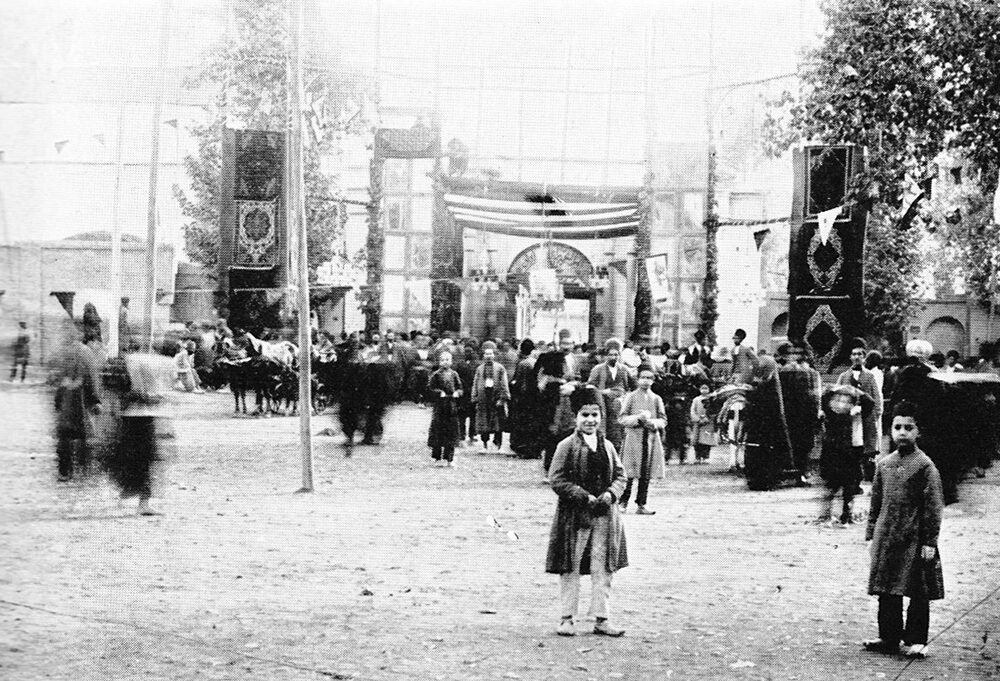
On July 31, 1909, a crowd gathered in Tehran’s Tupkhaneh Square to watch a cleric die.
Sheikh Fazlollah Nouri — senior mujtahid, respected theologian, once a supporter of the constitutional movement — was led to the scaffold. The constitutionalist forces who had just recaptured the capital from Mohammad Ali Shah’s royalist forces had tried him for treason: conspiring with the autocratic Shah against the constitutional government, agitating to destroy the Majles, and issuing religious decrees designed to undermine the democratic order that the Iranian people had built. The hanging was public and deliberate. The message was clear: religious authority did not confer immunity from accountability to the constitutional system.
Open an Iranian school textbook published any time since 1979, and you will find the same man presented as a hero — a visionary who fought against Western corruption and secular liberalism, a martyr who defended Islam against the disease of Gharbzadegi (Westoxification). His portrait appears in officially sanctioned histories. Streets are named after him.
The regime that governs Iran today reveres the man that the constitutional revolution executed for trying to kill democracy. That tells you everything about what the Islamic Republic’s official history is designed to hide. The story of what Nouri actually fought for — and why his defeat in 1909 was reversed so completely in 1979 — is one that Iran’s information ecosystem has buried for decades.
The Argument Iran Never Finished
The Iranian Constitutional Revolution of 1906 was not only a battle between the monarchy and the people. It was also a battle within the revolutionary coalition itself — a theological and political argument that has never been resolved.
The argument had two sides, and the shorthand is precise enough to be useful:
Mashruteh — constitutionalism. The position that sovereignty derives from the people, that a written constitution constrains all power including religious authority, and that the Majles is the supreme legislative body. Champions: reformist clerics like Ayatollah Mohammad Kazem Khorasani (who issued fatwas FROM Najaf supporting the constitution), secular intellectuals, merchants, the press.
Mashru’eh — Sharia-based governance. The position that all human legislation must conform to Islamic law as interpreted by qualified jurists, and that no parliament has the authority to pass laws that contradict the faqih’s understanding of divine law. Champion: Sheikh Fazlollah Nouri.
Nouri was not a marginal figure. He was a respected senior cleric in Tehran — a mujtahid with a significant following. He had initially supported the constitutional movement, joining the Great Bast of 1906. His break came when he saw the direction the Majles was taking: secular courts that could overrule religious tribunals, press freedom that allowed criticism of clerical authority, legal reforms that treated all citizens as equal regardless of their religious status.
For Nouri, this was apostasy. A parliament that could legislate independently of Islamic jurisprudence was, by definition, illegitimate. He began publicly opposing the constitution, issuing proclamations that the Majles was a vehicle for kufr (unbelief) and Western corruption. He organized counter-demonstrations. When Mohammad Ali Shah bombarded the Majles in June 1908, Nouri sided with the royalists — providing religious legitimacy for the autocratic coup.
What Article 2 Actually Said
The compromise between Mashruteh and Mashru’eh was encoded in Article 2 of the Supplementary Fundamental Laws, ratified in October 1907.
The article mandated the creation of a committee of “not less than five” mujtahids — senior Islamic jurists — who would review all legislation passed by the Majles to ensure compatibility with Islamic law. Laws found to be in conflict with Islam could be vetoed.1
Article 2 (1907): The Clerical Review Committee
- A committee of five or more mujtahids
- Selected from a list of twenty nominated by the Majles, with final selection by the maraje (senior clerical authorities)
- Mandate: review legislation for Islamic compliance
- Power: veto laws deemed un-Islamic
- Nature: a negative check — preventing anti-Islamic legislation, not prescribing Islamic legislation
The last line is where the trap door opens. Article 2 was designed as a brake, not an engine. It could stop the Majles from passing laws that explicitly contradicted Islamic principles. It could not compel the Majles to pass Islamic laws. It could not initiate legislation. It could not dictate governance. The sovereignty of the Majles was preserved — Article 2 gave the clergy a defensive wall, not a throne.
In practice, the committee was never properly constituted. After the initial constitutional period, and especially after Nouri’s execution in 1909, Article 2 became a dead letter — acknowledged on paper, ignored in governance.2 The constitutionalists treated it as the price of coalition-building: a concession to the religious faction that had been necessary to win clerical support for the revolution, but not a binding constraint on parliamentary sovereignty.
The Execution
After the constitutionalist forces recaptured Tehran in July 1909, Nouri was arrested. His trial was brief. The charges were treason and conspiracy with the autocratic Shah against the constitutional government.
The execution was public and deliberate. Nouri was hanged in Tupkhaneh Square — one of Tehran’s central plazas — in front of a large crowd. The constitutionalists intended the execution as a signal: the democratic order would not tolerate those who conspired with autocracy to destroy it, regardless of their clerical status. Religious authority did not confer immunity from accountability to the constitutional system.
The execution was also a failure of the constitutionalists’ own principles. A movement built on the rule of law conducted a trial that was, by most accounts, hasty and procedurally thin. Senior maraje in Najaf who had supported the constitution expressed discomfort — not because they supported Nouri’s politics, but because a democratic order that executes its opponents without rigorous due process weakens the moral authority it needs most. The constitutionalists chose security over procedure, and that choice left a crack that the regime’s historians would later exploit.
But the comparison the Islamic Republic draws between Nouri’s execution and its own treatment of dissidents collapses under scrutiny. One man was executed after a trial — however imperfect — in a public square, with charges stated and a verdict rendered. The Islamic Republic has executed thousands in secret, without legal representation, without public proceedings, without even notifying families until the burial was complete. One execution was a flaw in a democratic system. The other is the system itself.
The Resurrection
Seventy years later, the Islamic Republic reversed the verdict.
After the 1979 revolution, the new regime undertook a systematic rewriting of the constitutional revolution’s history. The central reframing: the 1906 revolution was not a democratic achievement but a foreign plot — an attempt by Western-influenced intellectuals and secular nationalists to undermine Islam and impose godless European models on a Muslim society. The clerics who supported the constitution (like Khorasani) were minimized. The cleric who opposed it (Nouri) was elevated.
In the Islamic Republic’s school textbooks, Nouri is portrayed as a prescient defender of Islamic values who saw through the Western deception that animated the constitutional movement.3 His opposition to secular courts, to press freedom, to legislation unconstrained by clerical authority — all the positions that got him hanged — are presented as prophetic wisdom. The constitutionalists who executed him are recast as agents of foreign influence.
This is not a minor historical quibble. The Islamic Republic’s rehabilitation of Nouri is a declaration of ideological identity: the regime identifies itself with the anti-constitutionalist tradition, not the constitutionalist one. It traces its lineage not to the fourteen thousand people in the garden demanding a parliament, but to the one cleric who wanted that parliament subordinated to divine law.
From Brake to Engine
The ghost of Article 2 did not merely haunt the 1979 constitution. It possessed it — and in the possession, transformed into something Nouri himself might not have recognized.
The 1979 Constitution of the Islamic Republic established the Guardian Council — twelve members, six Islamic jurists appointed by the Supreme Leader and six civil jurists nominated by the head of the judiciary and approved by the Majles.4 The Guardian Council reviews all legislation for compatibility with both Islamic law and the constitution. It also vets all candidates for public office — deciding who is allowed to run for parliament or the presidency.
Above the Guardian Council sits the doctrine of Velayat-e Faqih — the Guardianship of the Jurist — which grants the Supreme Leader authority over the judiciary, the military, state media, and the right to override any decision by any branch of government. The Supreme Leader is not elected by popular vote. He is selected by the Assembly of Experts — itself vetted by the Guardian Council, creating a closed loop of clerical self-selection.
The transformation from Article 2 to Velayat-e Faqih is the central constitutional tragedy of modern Iran:
1906 Article 2 vs. 1979 Guardian Council
- 1906: Negative veto — clerics could BLOCK un-Islamic legislation
- 1979: Positive mandate — clerics PRESCRIBE governance, vet candidates, control judiciary and military
- 1906: Committee of five, selected from Majles nominees
- 1979: Twelve members, six appointed directly by the Supreme Leader
- 1906: Majles retained sovereignty — Article 2 was a defensive check
- 1979: Majles subordinated — Guardian Council can reject any law AND any candidate
- 1906: In practice, ignored after 1909
- 1979: In practice, the most powerful institution in the state
Consider what this means in practice. When an Iranian votes for a parliamentary candidate, the Guardian Council has already decided who is allowed to run. The ballot is pre-filtered by unelected clerics before the voter ever sees it. Americans frustrated by gerrymandering or primary systems that limit their choices are experiencing a faint echo of this — a system that performs the ritual of democracy while engineering its outcomes. The difference is one of degree. But the degree is everything.
Article 2 was a brake on a democratic engine. Velayat-e Faqih replaced the engine entirely. The passengers — the Iranian people — were removed from the driver’s seat and told that divine law required them to sit in the back. The Supreme Leader, unelected and irremovable, drives.
From Brake to Engine
1906 — Article 2
- Role: Defensive veto
- Members: 5 senior clerics
- Power: Review laws for Islamic compliance
- Activation: Never convened
- Real effect: Dead letter from day one
1979 — Guardian Council
- Role: Positive mandate
- Members: 12 (6 clerics + 6 jurists)
- Power: Veto laws + vet candidates
- Activation: Every election, every law
- Real effect: Most powerful institution in Iran
The Debate That Was Never Won
The deepest irony is that the Mashruteh vs. Mashru’eh debate — constitutionalism versus Sharia-based governance — was never intellectually resolved. It was resolved by force, twice.
In 1909, the constitutionalists won by capturing Tehran and hanging Nouri. They did not win the theological argument. They won the military campaign. Article 2 remained in the constitution as a concession — a reminder that the clerical faction had been co-opted, not persuaded.
In 1979, the Mashru’eh faction won by riding a mass revolution against the Shah and then systematically eliminating every other faction in the revolutionary coalition. They did not win the democratic argument. They won the power struggle. Velayat-e Faqih was installed under the cover of the hostage crisis — in an atmosphere of emergency and xenophobia where opposition was labeled treason.5
Neither side won the argument. Each side won a war. And the fact that the debate remains unresolved — that the tension between popular sovereignty and clerical authority is still the central fault line of Iranian politics — explains why the Islamic Republic treats the constitutional revolution with such anxiety. The regime cannot embrace 1906, because 1906 represents the tradition that says the people are sovereign. It cannot ignore 1906, because 1906 is the most powerful evidence that Iranians have an indigenous democratic tradition. So it rewrites 1906 — celebrating the man who lost and erasing the movement that won.
The ghost of Article 2 is not a metaphor. It is the structural code of the Islamic Republic — a provision that the constitutionalists thought they had neutralized, that lay dormant for seventy years, and that was resurrected in a form so expanded that it consumed the entire constitutional framework it was originally designed to constrain. Nouri’s brake became Khomeini’s engine. The passengers are still waiting to retake the wheel.
This article is a companion to The First Try. For the full story of the American who fought for Iran’s democracy, see The Strangling of Persia. For the free press that the Shah’s Cossacks silenced, see The Press Boom of 1906. For how the 1979 constitution was installed under the cover of a crisis, see 444 Days. For the forensic record of every Paris promise broken, see The Paris Deception.
Footnotes
-
Foundation for Iranian Studies, “Iran 1906 Constitution,” Supplementary Fundamental Laws, Article 2, October 1907 ↩
-
Janet Afary, “The Place of Shi’i Clerics in the First Iranian Constitution,” Critical Research on Religion, 2013 ↩
-
Iran Primer (USIP), “Part II: Iran’s Controversial Textbooks,” August 2011; Manara Magazine, “120 Years of Tension: Constitutionalism and Shari’a-Based Governance in Modern Iranian History,” January 2026 ↩
-
Cambridge University Press, “Islamic Constitutionalism: Iran,” Chapter 20, Constitutionalism in Context ↩
-
Manara Magazine, “120 Years of Tension: The Conflict Between Constitutionalism and Shari’a-Based Governance in Modern Iranian History,” January 2026 ↩