The Garden
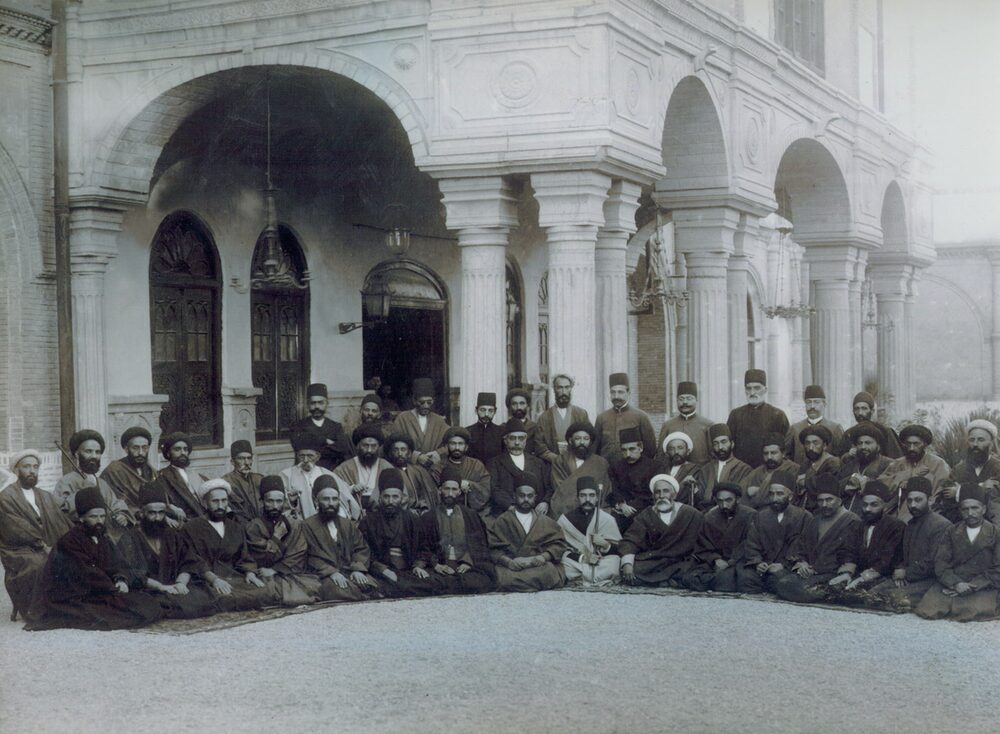
In the summer of 1906, more than fourteen thousand people were living in a garden.
They had come from every quarter of Tehran — merchants who locked their shops in the Grand Bazaar, theological students from the seminary at Sepahsalar, tradesmen and guild masters, moneylenders, even a few sympathetic government clerks. They came carrying bedrolls, tea sets, and a single, shared demand: the Shah must grant them a constitution.
The garden belonged to the British Legation in Tehran — a twenty-seven-acre compound that had become, by custom and international law, a sanctuary where the Shah’s soldiers could not follow. The tradition was called bast — asylum — and the men who filled every path and lawn of that compound turned it into the largest continuous act of civil disobedience the Middle East had ever seen.
They called it the “school of open air.” They organized themselves into committees. They held debates and drafted petitions. Reformist clerics delivered sermons. Bazaar leaders coordinated food and supplies. What had begun weeks earlier as a vague demand for a “House of Justice” — Adalatkhanah — hardened, day by day, into something far more specific and more dangerous: a written constitution. Qanun-e Asasi. A National Consultative Assembly. Majles. The rule of law over the rule of the king.1
Muzaffar al-Din Shah — weakened by kidney disease, shaken by the scale of the protest, and unable to command the military loyalty needed to disperse fourteen thousand people from a foreign legation — signed the decree on August 5, 1906.2 Iran had a parliament. The first indigenous democratic revolution in the Middle East was complete — predating the Ottoman Young Turk Revolution by two years, the Chinese Revolution by five.
The question this creates — the one the simplified narrative about Iran cannot answer — is this: if democracy is something that needs to be “brought to” the Middle East, who brought it in 1906?
The Match
The revolution that built a garden-parliament had begun with sugar.
In December 1905, the price of sugar spiked across Tehran — a convergence of a bad harvest, trade disruption from the Russo-Japanese War, and a cholera epidemic that strangled supply lines. Tehran’s governor, Ala al-Dawla, responded by ordering the bastinado — public foot-whipping — of two respected sugar merchants. One of them was a sayyed, a descendant of the Prophet Muhammad.
That was the match. It united the two most powerful non-state forces in Iran: the mosque and the bazaar. An attack on commerce AND religious dignity simultaneously. The ulama declared the punishment an insult to Islam. The bazaaris declared a general strike. Together, they formed a coalition that no shah could suppress by force alone — because the mosque controlled the narrative and the bazaar controlled the economy.
But the sugar was only the trigger. The fuel had been accumulating for decades.
In 1891, Naser al-Din Shah had sold a monopoly over Iran’s entire tobacco trade to a British company — the Tobacco Régie. Grand Ayatollah Mirza Shirazi issued a fatwa from Samarra declaring tobacco use tantamount to “war against the Hidden Imam.” The boycott that followed was so total it was observed even in the Shah’s own harem — his wives put down their water pipes. The Shah canceled the concession.3 An entire nation had organized against foreign exploitation and won, fourteen years before the constitutional movement began.
The Tobacco Protest proved three things that would become the architecture of 1906: religious authority could mobilize the masses beyond the reach of the state; collective action across class lines could force a monarchy to capitulate; and the fundamental issue — foreign powers extracting Iranian resources while Iranians had no say in their own governance — was a wound that would not heal without structural change.
More Radical Than Japan
The constitution that emerged from the Great Bast was not a derivative document. In key respects, it was more radical than the models its drafters claimed to admire.
Iranian intellectuals were obsessed with Japan after the Russo-Japanese War of 1904–05 — a non-Western power that had modernized enough to defeat a European empire. But the Meiji Constitution of 1889, which they hoped to emulate, vested sovereignty in the “sacred and inviolable” Emperor. The Ottoman Constitution of 1876, revived by the Young Turks in 1908, was granted by the Sultan and could be suspended at will. The Iranian constitution placed sovereignty in the people.
Comparative Constitutional Structures
- Iran 1906: “Sovereignty is a trust confided by the people to the person of the King” (Article 35) — first legal recognition of the citizen (shahrvand) in the Islamic world, replacing “subjects” (ra’iyat)
- Japan 1889: Sovereignty vested in the Emperor, “sacred and inviolable” — the Diet was advisory
- Ottoman Empire 1876/1908: Constitution granted by the Sultan, who retained dismissal powers over parliament
Article 35 of the Supplementary Fundamental Laws was the most radical sentence in Iranian political history. The king was not the source of sovereignty — he was its trustee.4 The Majles had supreme budgetary authority, rejecting foreign loans without parliamentary approval. The document included an explicit bill of rights: freedom of the press, freedom of association, protection of property.
The First Majles convened in October 1906 — and its legislative record was remarkable. It abolished tiyul — feudal tax farming — created secular courts (Adliyeh) with habeas corpus, asserted absolute budgetary sovereignty, and proposed a National Bank funded by Iranian citizens rather than foreign creditors.
The First Majles (October 1906):
- 156 seats — roughly 45% merchants and guild masters, 20% clergy, 25% landowners and notables
- Class-based representation, not universal suffrage — but the most democratic body in the region
- Key legislation: abolished feudal tax farming, created secular courts with habeas corpus, asserted budgetary sovereignty over foreign loans
Iran in 1906 was part of a global wave: Russia 1905, Iran 1906, Turkey 1908, Mexico 1910, China 1911. But Iran’s was the only constitutional revolution in the Middle East that emerged from a mass popular uprising rather than a military coup or an imperial grant. The Ottomans got their constitution from army officers. The Japanese got theirs from the Emperor. Iranians forced theirs from a garden.
The Bombardment
Muzaffar al-Din Shah died five months after signing the constitution. His son, Mohammad Ali Shah, inherited the throne and immediately plotted to destroy what his father had given.
Mohammad Ali Shah had deep sympathies for Russian autocracy — his tutor had been a Russian, his instincts were despotic, and he viewed the Majles as an intolerable constraint on monarchical power. He found his instrument in Colonel Vladimir Liakhov, commander of the Russian-officered Cossack Brigade — the only modern military force in Iran, and one that answered to Russian officers rather than the Iranian parliament.
On June 23, 1908, Liakhov’s artillery shelled the Majles building.5
The bombardment killed dozens of deputies and supporters. The parliament that had governed for less than two years was physically destroyed. The free press that had exploded into existence during the constitutional period — dozens of newspapers, pamphlets, satirical broadsheets that had democratized political language for the first time in Iranian history — was silenced overnight.
Mirza Jahangir Khan, editor of Sur-e Esrafil (“The Trumpet of Israfil”), the revolution’s most radical newspaper, was arrested. His columnist Dehkhoda had invented a new form of political writing — Charand Parand (“Nonsense and Stuff”) — using colloquial language so accessible it was read aloud to the illiterate in teahouses, turning complex political concepts into street wisdom. Mirza Jahangir Khan was taken to the Shah’s garden — the Bagh-e Shah — and strangled. The preacher Malek al-Motakallemin was killed alongside him.
Democracy in Iran appeared to be dead. The constitution had lasted twenty-two months.
The City That Refused
Except in Tabriz.
When Mohammad Ali Shah’s coup succeeded in Tehran, the city of Tabriz — Iran’s second city, connected by labor migration and revolutionary ideas to the Caucasus — refused to surrender. What happened there was the most extraordinary episode in the constitutional revolution — and the clearest proof of how deeply Iranians valued democratic governance, enough to hold a city under siege for a year.
Sattar Khan was not a politician. He was a lutī — a neighborhood strongman from the Amirkhiz quarter, a man of the streets who had spent time in prison and earned his reputation through physical courage, not education. Baqir Khan was a merchant. Together, they organized a resistance that held Tabriz against the royalist siege for nearly a year — outnumbered, outgunned, and without external support for months.
The coalition that defended Tabriz proved the multi-ethnic character of Iranian democracy: Armenian revolutionaries, led by Yeprem Khan, provided military organization and urban warfare expertise drawn from their experience in Caucasian liberation movements.6 The “Secret Center” — Markaz-e Ghaybi — maintained clandestine links to Russian Social Democrats in Baku. Azeri, Armenian, Persian — the constitutional revolution was not a Persian movement. It was an Iranian one.
Women formed the Anjoman-e Zanān — the Women’s Association — serving as couriers, fundraisers, and, in some cases, combatants. Contemporary reports describe women disguised as men fighting in the trenches around the besieged quarters. When casualties were counted after the heaviest engagements, female bodies were found among the fallen. Women also served as human shields during demonstrations, leveraging the cultural prohibition against attacking women to protect male protesters.
In July 1909, the constitutionalist forces finally executed a dramatic pincer movement on Tehran. From the north: troops from Rasht led by the Sipahdar and Armenian fedayeen. From the south: the Bakhtiari tribal confederation, led by Sardar Asad, who marched their forces across the Zagros Mountains. The two columns converged on the capital. They captured Tehran, deposed Mohammad Ali Shah, and restored the constitution.
It was the first time in Iranian history that a monarch was removed by popular will and replaced by parliamentary vote. The city that had refused to die had saved Iranian democracy.
The Strangling
The constitution had been born and reborn. Now the world killed it.
In 1911, the restored Majles hired William Morgan Shuster — a thirty-four-year-old American lawyer from Washington, D.C. — as Treasurer-General. His mission was to organize Iran’s finances without foreign loans, giving the constitutional government the economic independence it needed to survive. He was remarkably effective — establishing a tax gendarmerie, modernizing revenue collection, and asserting Iranian sovereignty over resources that Russia and Britain had long treated as their own.
Too effective. Russia and Britain had signed the Anglo-Russian Convention of 1907, dividing Iran into spheres of influence — Russia in the north, Britain in the south, a “neutral” zone between them — without consulting Iran.7 Shuster’s financial reforms threatened that arrangement. An independent, solvent Iranian government needed neither Russian “protection” nor British “guidance.”
Russia issued an ultimatum: dismiss Shuster or face military occupation.
The Majles voted to reject the ultimatum. It was an act of extraordinary courage — a small parliament in a weak state defying the Russian Empire. During the debate, a delegation of veiled women confronted the deputies, declaring they would kill their own husbands and then themselves rather than submit to Russian demands. William Morgan Shuster, the American who had come to organize a treasury, later wrote that “the Persian women became the embodiment of the nation’s conscience.”8
Imagine watching your parliament — the parliament your people built from a garden protest, defended through a siege, restored through a civil war — vote to stand against an empire. And then watching the empire send the troops anyway.
Russian forces invaded. In Tabriz — the city that had already bled for democracy once — Russian soldiers hanged constitutionalists on Ashura, the holiest day in the Shi’a calendar. It was a calculated desecration: executing defenders of democracy on the day that commemorates the martyrdom of Imam Hussein. The government, under extreme duress and facing military occupation, dissolved the Majles in December 1911.
Iran’s first democracy lasted five years. It was strangled by two empires who could not tolerate an independent, democratic state sitting on top of their strategic interests.
Shuster titled his account of the experience with the precision of a death certificate: The Strangling of Persia.
The Persian women since 1907 had become almost at a bound the most progressive, not to say the most radical, in the world. That this statement upsets the ideas of most Westerners regarding the women of Islam is natural.
The Honest Ledger
The constitutional revolution was not a perfect democracy. The record demands acknowledgment.
The electoral system was class-based: merchants, clergy, and landowners dominated the First Majles. Women could not vote. The Babi and Baha’i intellectual contribution to reform thought — significant and documented — is systematically erased by both Pahlavi and Islamic Republic histories, a double erasure that continues to this day.
Article 2 of the Supplementary Fundamental Laws, championed by the anti-constitutionalist cleric Sheikh Fazlollah Nouri, gave a committee of five mujtahids the power to review legislation for Islamic compatibility — a compromise that institutionalized religious oversight of democratic law.9 The constitutionalists largely ignored Article 2 in practice after Nouri’s execution for treason in 1909, but the compromise survived on paper.
And the constitutional period was marked by episodes of violence, regional fragmentation, and institutional weakness that would later be cited — by Reza Shah, by the Islamic Republic — as proof that Iran “needed” authoritarianism because democracy produced disorder.
Three Constitutions
| Iran 1906 | Japan 1889 | Ottoman 1876 | |
|---|---|---|---|
| Sovereignty | The people | The Emperor | The Sultan |
| Legislature | Elected Majles | Appointed upper house | Appointed Senate |
| Monarch's veto | Limited | Absolute | Absolute |
| Women's role | Funded the movement | Excluded | Excluded |
| Outcome | Strangled by foreign powers | Survived to 1947 | Suspended twice |
These are real limitations. But the comparison that matters is not between Iran’s 1906 constitution and a modern ideal. It is between Iran’s 1906 constitution and its contemporaries. By that measure — on sovereignty, on citizen rights, on legislative independence — the Iranian document was more radical than Japan’s, more popular than the Ottomans’, and more constrained in royal power than either. What ended Iran’s first democracy was not a cultural deficiency. It was an imperial assassination.
The Ghost
The constitutional spirit did not die in December 1911. It went underground — into the political DNA of every movement that followed, resurfacing whenever the constraints loosened: in 1941, when parliament regained genuine power; in 1951, when the Majles asserted sovereignty over Iran’s oil; in 1979, before the revolution was hijacked.
And the regime that built itself on the ruins of that tradition has an extraordinary relationship with the constitutional revolution. The Islamic Republic rehabilitated Sheikh Fazlollah Nouri — the cleric who fought against the constitution, who championed theocratic veto over democratic law, and who was hanged for treason in 1909 after the Shah’s defeat. School textbooks portray him as a hero and a martyr who resisted “Westoxification” (Gharbzadegi). The regime does not merely ignore the constitutional revolution. It celebrates the man who tried to kill it.
Nouri’s Article 2 — the clerical veto that the constitutionalists rendered a dead letter — was resurrected in 1979 as the Guardian Council and Velayat-e Faqih. A negative check that one anti-constitutionalist cleric had extracted as a compromise became the positive theocratic mandate that governs Iran today. The debate between Mashruteh (constitutionalism) and Mashru’eh (Sharia-based governance) — the central argument of 1906 — was never resolved. It was simply won, seventy years later, by the side that had lost.
Nouri lost in 1909. He won in 1979.
The Demand That Never Died
In the protests of 2017, 2019, 2022, and January 2026, the chants in the streets carry the same words that filled the gardens of the British Legation 120 years ago. Adalat. Justice. Azadi. Liberty.
The slogan “Woman, Life, Freedom” — Zan, Zendegi, Azadi — is a modern echo of the women who sold their jewelry to fund a National Bank, who disguised themselves as men to fight in Tabriz’s trenches, who told an American treasurer-general they would kill their own husbands before surrendering their country to a foreign ultimatum. The thread runs unbroken — from the Anjoman-e Zanān of 1906 through Farrokhroo Parsa in 1968 to Mahsa Amini in 2022.
The simplified narrative — that Iran is a theocratic culture inhospitable to democratic movements — requires ignoring 1906, 1941–1953, 1979 (before the hijacking), 2009, 2017, 2019, 2022, and January 2026. It requires believing that the demand for self-governance is a Western invention that must be exported, rather than what the evidence shows: a human impulse that the Iranian people have expressed, in their own language and on their own terms, for longer than most Western democracies have existed.
The first try ended because two empires could not tolerate a democratic Iran. The question worth sitting with is why, 120 years later, the story of a garden full of fourteen thousand people demanding a constitution still is not part of the picture most Westerners carry of Iran — and what that absence reveals about the information ecosystem that shaped the picture.
For the full story of the American who fought for Iran’s democracy, see The Strangling of Persia. For how the 1906 clerical compromise became the 1979 theocratic mandate, see The Ghost of Article 2. For the free press revolution that shook a monarchy, see The Press Boom of 1906. For the women’s rights thread that connects 1906 to 2022, see The Minister Who Was Hanged. For what Iranians actually want today, see What Iranians Actually Want. To test your knowledge of Iran’s hidden history, take The Iran Test.
Footnotes
-
Gresham College, “Iran’s Constitutional Revolution of 1906,” lecture transcript, 2024 ↩
-
Persian Constitutional Revolution, Encyclopaedia Iranica and Cambridge University Press, “A Dynastic History of Iran,” Chapter 3 ↩
-
Global Nonviolent Action Database, “Iranian Resistance to the Tobacco Concession, 1891–1892,” Swarthmore College ↩
-
Foundation for Iranian Studies, “Iran 1906 Constitution,” Article 35 of the Supplementary Fundamental Laws, October 1907 ↩
-
Encyclopaedia Iranica, “Constitutional Revolution i–vi”; IranWire, “An American with Iran Against the Russian Empire,” 2024 ↩
-
Persian Constitutional Revolution, multiple academic sources including Cambridge University Press and Charles Kurzman, “Intellectuals and the Constitutional Revolutions of 1905–12” ↩
-
RSIS International, “Iran’s Forgotten Friend William Morgan Shuster: Victim of Anglo-Russian Conspiracy” ↩
-
William Morgan Shuster, The Strangling of Persia, Century Company, New York, 1912 ↩
-
Janet Afary, “The Place of Shi’i Clerics in the First Iranian Constitution,” Critical Research on Religion, 2013; Athens Journal of History, “Sheikh Fazlollah Nouri’s Legitimate Constitutional Theory,” 2019 ↩