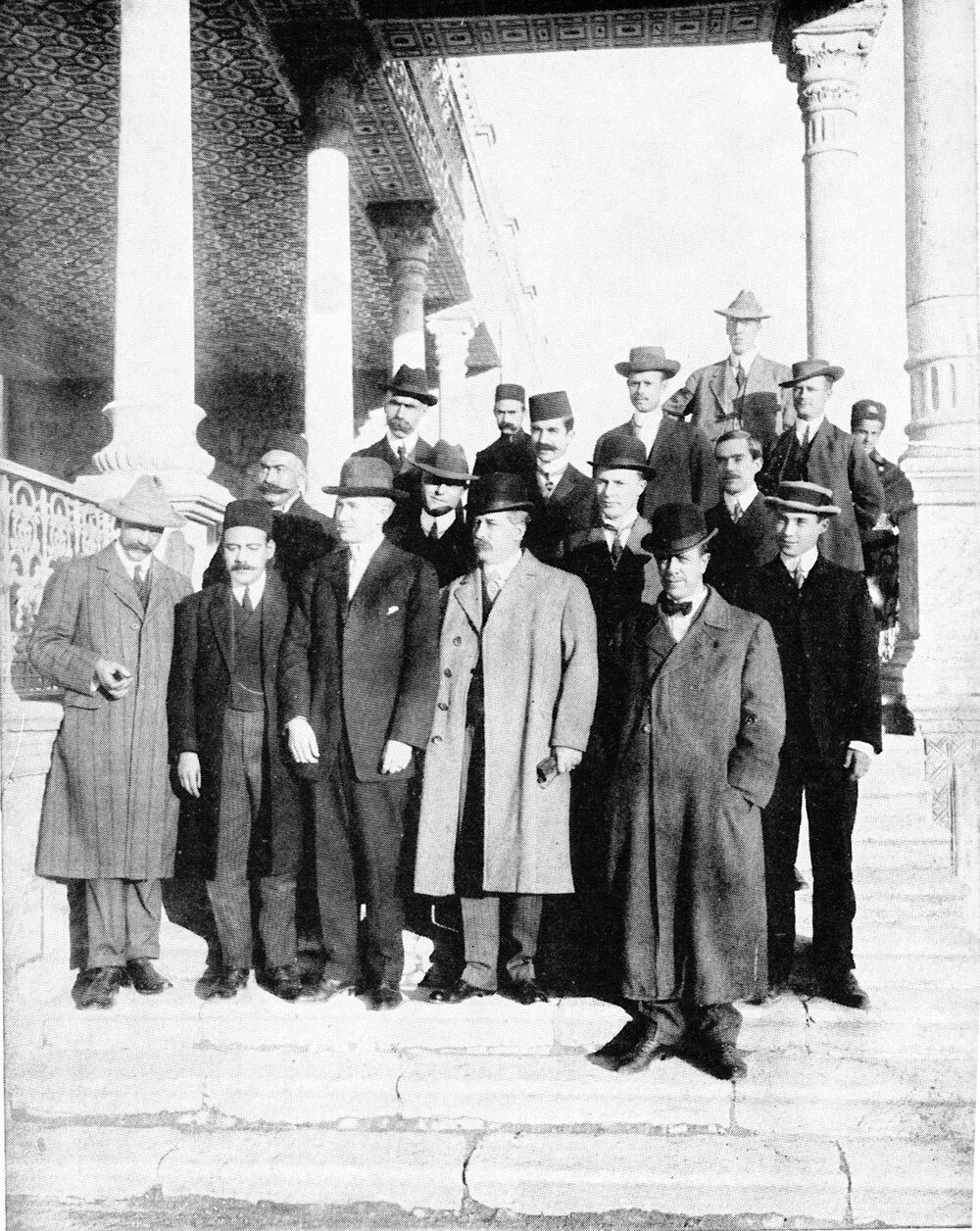
The American Who Chose Iran
William Morgan Shuster arrived in Tehran in May 1911 with a small staff of American advisors and a mandate that would make him the most dangerous man in the country: organize Iran’s finances without foreign loans.
He was thirty-four years old, a lawyer from Washington, D.C., who had previously worked on customs reform in the Philippines and Cuba. He had no particular expertise in Persia. He had no romantic illusions about the East. What he had was a contractual obligation to the Iranian Majles — the constitutional parliament that had survived a royal bombardment, a civil war, and the deposition of a king — and an apparently genuine belief that when a parliament hires you to do a job, you do it.
Within months, Shuster established a tax gendarmerie — a revenue collection force answerable to the Majles rather than to the court or foreign legations. He began modernizing the treasury, auditing accounts, and asserting Iranian sovereignty over revenue streams that Russia and Britain had long treated as their own prerogatives. He attempted to collect taxes from powerful individuals connected to the Russian legation — men who had assumed that their debts to the Iranian state were cancelled by their proximity to a great power.
He was, by every measure, exactly what the constitutional government needed: a competent, honest administrator with no loyalties to any foreign power and a contractual commitment to Iranian sovereignty. That was the problem.
The Convention Iran Never Signed
To understand why Shuster’s efficiency was an act of war, you need to understand the document that had divided Iran without Iran’s consent.
On August 31, 1907 — less than a year after the constitutional revolution succeeded — Britain and Russia signed the Anglo-Russian Convention.1 The agreement divided Iran into three zones: a Russian sphere of influence in the north (covering Tehran, Tabriz, Isfahan — the economic heartland), a British sphere in the southeast (covering the approaches to India and the emerging oil fields), and a “neutral” buffer zone between them.
Iran was not consulted. Iran was not a signatory. The Iranian government learned of the arrangement through diplomatic channels and protested formally. The protest was ignored.
The convention was not an alliance against Iran — it was a settlement between rivals. Britain and Russia had been competing for influence over Central Asia in what diplomats called “the Great Game.” By 1907, with Germany rising as a common threat, they decided to stop competing over Iran and instead share it. The cost of their détente was Iran’s sovereignty.
The Division:
- Russian zone (north): Tehran, Tabriz, Isfahan, Mashhad — Iran’s population centers, industry, and trade routes
- British zone (southeast): Kerman, Sistan, Baluchistan — strategic buffer for British India + emerging oil interests
- Neutral zone: The remainder — theoretically “independent,” practically contested
The constitutional revolution — which had happened the year before — was an inconvenience. A functioning Iranian parliament with budgetary sovereignty could reject foreign concessions, audit foreign debts, and assert control over revenue that both empires considered theirs. Shuster was the embodiment of that threat: an administrator who took the Majles’ authority literally.
The Crisis
The trigger came in the autumn of 1911. Shuster sent his gendarmerie to confiscate property belonging to Shua al-Saltaneh, a brother of the deposed Mohammad Ali Shah, who owed substantial taxes to the Iranian treasury. The property happened to be in the Russian sphere of influence. Russia claimed the action violated their prerogatives and demanded Shuster be dismissed.
On November 29, 1911, Russia delivered a formal ultimatum to the Iranian government: dismiss Shuster within forty-eight hours.2 The specific demands were:
- Dismiss Shuster immediately.
- Agree never to hire foreign advisors without Russian and British consent.
- Pay an indemnity for the “offense” of collecting Iranian taxes on Iranian soil.
The second demand was the kill shot. If Iran agreed never to hire foreign advisors without Anglo-Russian approval, the constitutional government’s ability to function independently would be permanently destroyed. The first demand targeted a person. The second targeted sovereignty itself.
The Majles Said No
The Majles debated the ultimatum on December 1, 1911.
The pragmatists argued for compliance. Russian troops were already massing on the northern border. Iran had no army capable of resisting a Russian invasion. The constitutional government was fragile, its treasury empty, its military a patchwork of tribal levies and a small gendarmerie. Accepting the ultimatum would preserve the form of constitutional governance, even at the cost of its substance.
The deputies who voted no understood what they were doing. They were choosing principle over survival — rejecting the ultimatum knowing that Russia would invade, knowing that the Majles itself might not survive.
During the debate, a group of women — accounts describe them as veiled, some carrying pistols beneath their robes — entered the parliament and confronted the deputies directly. They declared that if the Majles capitulated to Russia, they would kill their own husbands and then themselves, because a nation that surrendered its sovereignty to save its skin had already died. Shuster, recounting the scene in The Strangling of Persia, wrote:
“The Persian women since 1907 had become almost at a bound the most progressive, not to say the most radical, parsing, in the world. That this statement upsets the ideas of centuries makes no difference. It is a fact.”
He added that the women “became the embodiment of the nation’s conscience” — crediting them with a courage that many of the male deputies lacked.3
The Persian women became the embodiment of the nation's conscience. They marched, they organized, they funded a national bank with their own jewelry. The idea that Muslim women were passive spectators to history would have struck any observer in 1911 as absurd.
The Majles voted to reject the ultimatum.
The Troops Came Anyway
Russia invaded.
On December 24, 1911, Russian forces entered Tabriz — the city that had already defended the constitution through a year-long siege three years earlier. Russian soldiers hanged constitutionalists in the public squares. Reports describe executions carried out on Ashura — the holiest day of the Shi’a calendar, when Iranians mourn the martyrdom of Imam Hussein. The timing was either coincidental or calculated; the effect was devastating in either case. To execute defenders of a democratic constitution on the day that commemorates a man who died defying tyranny was a desecration that Tabrizis never forgot.
The Iranian government, facing military occupation and the threat of further territorial losses, capitulated. Shuster was dismissed. The Majles was dissolved. The American treasurer-general who had organized a functioning treasury in seven months was escorted out of the country. The constitutional experiment was over.
Shuster sailed home to Washington and wrote his account. The title — The Strangling of Persia: A Story of the European Diplomacy and Oriental Intrigue That Resulted in the Denationalization of Twelve Million Mohammedans — is Victorian in its verbosity, but the subtitle captures the mechanism with precision: European diplomacy killed Iranian democracy.4 Not Iranian culture. Not Islam. Not political immaturity. Diplomacy — the Anglo-Russian Convention, the ultimatum, the troops.
The book was published in 1912 by the Century Company in New York. It was a bestseller. It was reviewed favorably. It changed nothing.
What Shuster Understood
Reading The Strangling of Persia in 2026 is a disorienting experience, because Shuster understood things about Iran that much of the Western foreign policy establishment still does not.
He understood that the constitutional movement was genuine — not a Western import, not an elite affectation, but a mass democratic uprising rooted in indigenous demands for accountability and sovereignty. He understood that the women of the constitutional movement were not peripheral figures but its moral center. He understood that Russia and Britain’s division of Iran was not a response to Iranian weakness but a cause of it.
He wrote about the Iranian people with a respect that is strikingly absent from most Western commentary about Iran, then and now. He did not sentimentalize them. He recorded their factionalism, their political inexperience, and their administrative disorganization with the same precision he applied to Russian ultimatums and British complicity. But he was clear about where the blame lay:
“It was obvious that the people of Persia deserved much better than what they were getting… and that the foreign powers in whose custody Persia’s affairs had been placed were in every sense unfit for the trust.”
An American in 1911 understood that Iranians deserved self-governance and that foreign powers were destroying it. More than a century later, the same dynamics play out: an Iranian population demanding democracy, external powers dictating terms, and a Western commentary class that treats Iranian self-governance as a problem to be managed rather than a right to be respected.
The Arc That Followed
The strangling of Persia in 1911 did not end the constitutional project. It forced it underground.
Reza Khan’s 1921 coup and subsequent coronation as Reza Shah in 1925 nominally preserved the 1906 Constitution but hollowed it out completely. The Majles became a rubber stamp. The press was censored. The constitutional framework survived as legal fiction while actual power concentrated in a modernizing autocrat who viewed parliament as an obstacle to national development.
When Reza Shah was forced to abdicate by the Allied invasion in 1941, the constitutional project resurfaced immediately — proof that the democratic impulse had been suppressed, not extinguished. The Majles regained genuine power. Political parties proliferated. The press became free. Oil nationalization in 1951 was the economic corollary of 1906: the same fight against foreign extraction of Iranian resources, the same insistence on parliamentary sovereignty.5
The constitutional crisis of 1953 — far more complex than the “CIA overthrew democracy” version most people have heard — severed the arc again. And in 1979, the revolution that was supposed to restore it devoured it instead.
Iran's Constitutional Arc
Shuster would not have been surprised. He had seen the pattern before. He had been the pattern’s victim. The title he chose for his book was not a metaphor. It was a diagnosis: Iran’s constitutional project was not killed by its own people. It was interrupted — by empires in 1911, by a hybrid crisis in 1953, and by a theocratic hijacking in 1979. The thread kept breaking. The people kept picking it up.
The Book That Should Be Famous
The Strangling of Persia is available in full on the Library of Congress website. It is one of the most important primary sources on Iran’s democratic history. It is virtually unknown in mainstream Western discourse about Iran.
There is a name for this kind of forgetting. Researchers call it the availability heuristic — we judge how common or important something is by how easily examples come to mind. When Iran’s democratic history is never mentioned in news coverage, never assigned in university courses, never referenced in foreign policy debates, its absence becomes self-reinforcing. The less you hear about it, the less you think there is to hear about. The result is not a conspiracy of silence. It is something more effective: a default of neglect.
If you have ever heard someone say that Iran has no democratic tradition, or that Iranians need democracy “brought to them,” or that the Middle East is culturally incompatible with self-governance — the corrective is a book written by an American government official in 1912, sitting on a public server, free to read, describing in precise detail how Iranians built a democracy, fought for it, and lost it to the same Western powers whose heirs now question whether Iranians are “ready” for self-governance.
The irony is not subtle. It is not even irony. It is a historical fact hiding in plain sight — the way the best-documented facts about Iran usually hide: not behind a paywall or a classified stamp, but behind the assumption that there is nothing worth looking for.
This article is a companion to The First Try. For how the 1906 clerical compromise became the 1979 theocratic mandate, see The Ghost of Article 2. For the press revolution that democratized political language, see The Press Boom of 1906. For the 1953 coup that severed the constitutional arc a second time, see The Coup That Wasn’t. To test what you know about Iran’s hidden history, take The Iran Test.
Footnotes
-
RSIS International, “Iran’s Forgotten Friend William Morgan Shuster: Victim of Anglo-Russian Conspiracy” ↩
-
IranWire, “An American with Iran Against the Russian Empire: William Morgan Shuster,” 2024 ↩
-
William Morgan Shuster, The Strangling of Persia, Century Company, New York, 1912, Chapter XVI ↩
-
Library of Congress, “The Strangling of Persia,” catalog record 12016068, 1912 ↩
-
Cambridge University Press, “A Dynastic History of Iran,” Chapter 3; Texas National Security Review, “The Collapse Narrative,” November 2019 ↩